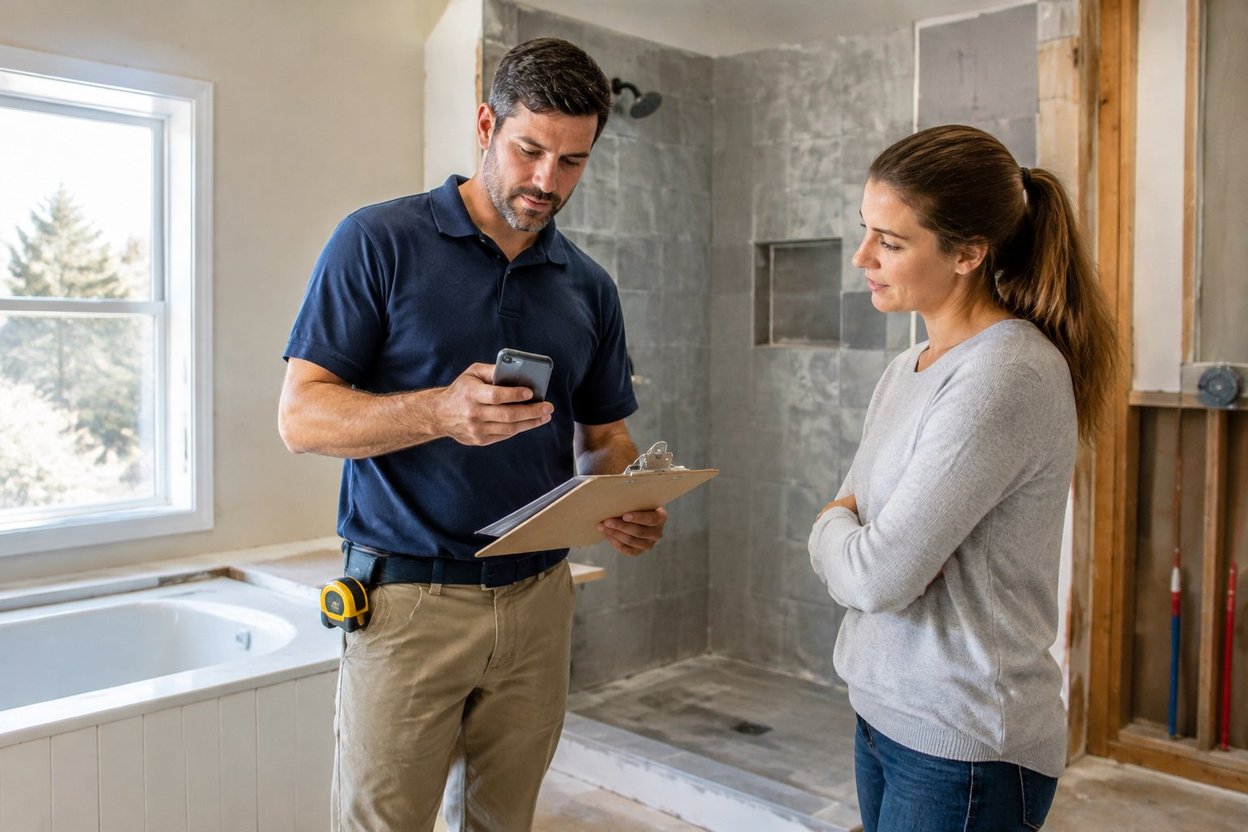
You're standing in a customer's bathroom in late October. They want it finished before family shows up for Thanksgiving, and they ask, "This doesn't need a permit, does it?" You could ask ChatGPT right there in the driveway, and you'd get an answer in seconds. Should you trust it? Not by itself. I'd use AI to do the digging and to write up good questions. I wouldn't count on its answer until the department that handles that address has confirmed it. Here's how to do that without losing your evening.
My answer: use AI to help check, then verify locally
I would use AI to help research a permit question. I would verify its answer with the department handling that address before relying on it.
The problem isn't that AI is always wrong. The problem is that when it's wrong, it sounds just as sure as when it's right. The National Institute of Standards and Technology (NIST) says in its generative AI risk profile that these tools can produce false information in a confident tone. Anthropic, the company that makes Claude, publishes its own guidance on reducing these made-up answers (called "hallucinations"). So a confident answer tells you nothing about whether it's correct.
The permit offices say much the same about their own pages. Fairfax County, Virginia, and Portland, Oregon, both publish lists of projects that do and don't need permits, and both point people with open questions to their staff. A general list isn't a ruling on your job.
What follows is my recommendation for how to work. It isn't a legal rule that applies everywhere. AI is a terrible master but a great servant. Let the apprentice do the reading and drafting. You make the calls.
Describe the actual job before asking the question
"Bathroom repair" isn't a question anyone can answer, whether it's a chatbot or a permit clerk. It could mean new caulk or a new subfloor and a moved drain. Before you ask anybody, write down:
- Property address and jurisdiction. City, county or state. Don't assume you know which office handles it.
- Building type and use. Single-family, duplex, condo, rental, commercial.
- Existing conditions. What's there now and what shape it's in.
- Exactly what's being removed, repaired, replaced or moved.
- Dimensions. Square footage, wall lengths, heights.
- Systems touched. Any plumbing, wiring, gas, structural or exterior work.
The building type matters because the rules can change with it. Portland's residential permit guide covers one- and two-family homes only. Fairfax County says the type of permit depends on the scope of work. The jurisdiction matters too. Oregon's Building Codes Division points applicants to a directory of local building departments, and in some counties the state runs the building department itself. Check who actually handles that address.
The most important line to draw is between replacing a finish and changing what holds it up. Here's a made-up example. You quote new floor covering in a bathroom. You pull up the old floor and find rotted framing underneath, and you and the owner decide to replace it. That's no longer the job you described. It's a different question, and it may have a different answer.
Why "just a repair" doesn't settle it
There's more than one kind of approval. A building permit covers construction. Trade permits cover plumbing, electrical and mechanical or gas work, often separately. Then there can be other approvals, like zoning or other agencies. A job can be exempt from one and still need another.
Two real examples show how much this varies. The details belong to these places only.
Portland, Oregon (one- and two-family homes covered by its guide): - Replacing interior floor covering and installing cabinets are on the list of work that doesn't need a building permit. - Replacing a water heater does need a plumbing permit. So does replacing a fixture when concealed plumbing connections are involved.
So in Portland, the new vanity cabinet might not need a building permit, but swapping the fixture on it could need a plumbing permit, depending on the connections. One bathroom, two answers.
Fairfax County, Virginia: - The county's general list of residential work that requires permits includes direct replacement of household appliances. - The same list includes installing or removing nonstructural walls.
Plenty of guys would call both of those "just a repair" or "not structural, so it's fine." Fairfax County's general guidance doesn't see it that way.
One more catch. Being exempt from a building permit doesn't mean the rules stop applying. Portland says exempt projects still have to meet building and zoning requirements. Fairfax County warns that approvals from other agencies may still be needed. "No permit" doesn't mean "no rules."
Give the apprentice a useful assignment
This is where AI earns its keep. Reading a city's permit pages takes time, and most of us would rather be on a job. A vague question gets a vague answer. A clear assignment gets you something you can check.
Here's a prompt you can copy. It's a tool for organizing the research, not a promise that the answer will be right:
> Help me research permit requirements for [address and jurisdiction]. Building type/use: [details]. Exact work: [details]. Find the responsible government department and its current official guidance. Separate building, electrical, plumbing, mechanical/gas and other approvals. Link each source and show the wording supporting each conclusion. Identify exceptions and missing information. If you cannot open a source or confirm the answer, say so. Draft the questions I should ask the permit office.
Every line in that prompt has a job. Asking for links and the exact wording follows advice from NIST, which recommends checking any citations the AI produces, and from Anthropic, which recommends checking claims against supporting quotes. Telling it to say "I can't confirm this" matters too. Anthropic recommends letting the model admit uncertainty and keeping it to the documents you give it. Anthropic also says these techniques can't get rid of made-up answers entirely.
That leaves part of the job to you. Open every link. Check that it's an official government page, that it covers the right city or county, and that the quoted wording is actually on it and actually supports what the AI said. If a link is dead, or the quote isn't there, or the page covers a different building type, throw that part out.
Watch out for forum threads too. A Reddit discussion about a Portland porch repair has people confidently giving each other opposite advice about permits. That's handy for seeing what customers are confused about. It's no good for deciding what the rule is.
Ask the permit office a question it can answer
After the apprentice has done the reading, you'll have one of two things: a clear official answer, or a list of questions. Either way, a short message to the department can settle it. Permit offices do invite these questions. The City of Fairfax, Virginia, tells people who aren't sure about permits to call or email Code Administration. Fairfax County invites questions to its Land Development Services staff.
Make it easy for them to answer. Here's a template:
> I'm quoting work at [address], a [building type/use]. We plan to [precise scope], including [systems affected]. We are keeping/changing [relevant details]. Does this require a building permit, any trade permits or another approval? Which exemption applies if no permit is required? Who may apply and perform the work, and what inspections are needed?
A few practical things help:
- Attach photos and measurements. If you can text a photo, you can attach one to an email.
- Ask for the answer in writing. It's easier to look back at, and harder to misremember.
- Save the reply with the scope you described. The answer only covers the job you asked about.
Be clear about what that email is and isn't. It's a record of what you asked and what they told you. It isn't a permit, and I wouldn't treat it as legal protection. If they say you need a permit, pull one.
The question about who may apply and do the work is there on purpose. Rules about who can pull a permit and who can do trade work vary. Get that answered before you quote, not after.
Keep the answer tied to the scope
A permit answer is only good for the job you described. If the job changes, check again. If you open a wall or pull a floor and find damage that adds to the work, check again before you fix it. The rotted framing in the earlier example is the kind of thing that turns a finish job into a different question.
Keep the paper trail in the job folder:
- The official page you relied on, and the date you checked it
- The department's response
- Any permit documents and inspection records
Note the date because rules change, and many official pages don't say when they were last updated.
Some cities now use specialized AI tools for permit review. Stateline reports that one of them, CivCheck, is meant to support human decision-making, not replace it. That's a city's own staff using a purpose-built tool. It doesn't mean a general chatbot can sign off on your repair.
So here's the workflow. Write the scope. Have the apprentice research it with sources. Open the links and check them yourself. Send the permit office a clear question with photos. Save the answer with the job. Check again if the scope changes. The AI does the reading and drafting. The permit office makes the ruling. You decide what to quote and what to build.
Sources (8)
- NIST, Artificial Intelligence Risk Management Framework: Generative AI Profile (NIST AI 600-1)
- Anthropic, Reduce hallucinations
- Fairfax County, Virginia, When is a permit required?
- City of Portland, Oregon, Residential permits: do you need a permit?
- Oregon Building Codes Division, Permit services
- City of Fairfax, Virginia, Permit FAQs
- Reddit r/askportland, Front porch repair: permit or...
- Stateline, Cities turn to AI to speed housing permitting