

You've probably typed a question into Google this fall, maybe what a part costs or which tool to buy, and got a paragraph of AI answer at the top before any website. The headlines say these AI Overviews now show on about 88% of commercial searches. That number is real, but it comes from banking, software and online shopping searches, not contractor searches. When a homeowner asks what a job costs, the AI answer shows up almost every time. When they're looking for someone to hire, it shows up far less, and in some towns not at all. Here's what that means for your phone.
Where the 88% comes from
The figure comes from a Semrush study published October 21, 2026. Semrush tracked 400 US desktop keywords in three industries (banking, software and ecommerce) from September 2025 through August 2026. Those keywords were the kind people type when they're close to buying: "alternatives to," brand-versus-brand comparisons, recommendations, pricing and reviews.
Over that year, the share of those searches showing an AI Overview went from 45.75% to 88%. When Semrush weighted the same keywords by how often people search them, coverage reached 97.08% in August 2026. Search Engine Land, which covered the study, pointed out that it did not measure clicks or sales. It measured whether the AI box appeared, and nothing else.
A separate, much bigger Semrush study looked at more than 600,000 US desktop keywords and found that AI Overviews on buying-type searches grew 71% between November 2025 and April 2026. That's a growth rate. It doesn't mean 71% of searches have one.
So the honest version of the headline is this: on certain national buying searches outside the trades, AI answers are now close to everywhere. Nobody in that study was looking for a roofer.
What the contractor numbers say
Several other groups have tested searches closer to our work. They used different dates, devices and methods, so I've put those details next to each number. A percentage without them can mislead you.
- Suff Digital, September 23, 2026. 20,000 US commercial and service keywords across 24 industries. AI Overviews showed on 11,512 of them, or 57.6%. In a matched set of 10,000 keywords, it was 61.2% on mobile versus 55.4% on desktop. By trade: electrical 70.9%, plumbing 49.3%, home remodeling 40.7%.
- Siana Marketing, October 20, 2026. 200 US desktop keywords across eight construction and real-estate-related trades, using national results with no city. All 55 cost questions got an AI Overview. Only 32 of the 76 "hire," "best" and "near me" searches did, which is 42%.
- Whitespark, May 12, 2025. 540 searches tested by hand across six industries, plumbing included, in Houston, Phoenix and Denver. The researchers weren't physically in those cities. For plain local searches, AI Overviews showed 15% of the time and the map pack showed 93%. Informational searches got an AI Overview 92% of the time. Searches mixing a question with local buying intent got one 97% of the time.
- 1-FIND SERVICES, June 2026. 135 contractor searches covering HVAC, plumbing, electrical, roofing and tree services in Johnson City, Kingsport and Bristol, Tennessee. Zero AI Overviews. The agency itself said conditions can change.
These studies don't line up exactly, and they shouldn't, because they measured different things. Taken together, though, they point the same way.
One homeowner, two different searches
A homeowner thinking about a new roof usually searches twice. First comes research: "how much does a roof replacement cost," "metal vs shingle," "how long does siding last." Later comes hiring: "roofer near me," "best siding contractor in [town]."
The AI answers have mostly taken over the first kind. In Siana's sample, every cost question got one. Whitespark found them on 92% of informational searches.
The second kind is still mostly the map pack and regular results. AI showed on 42% of hiring searches in Siana's national test, 15% of local searches in Whitespark's, and none in the Tennessee test.
Your trade matters too. An electrician and a remodeler are in different situations: in Suff Digital's data, electrical searches got AI answers 70.9% of the time and remodeling 40.7%.
Emergency searches haven't been settled either way. Nobody has shown that "burst pipe at 2 a.m." searches are safe from AI answers. Nobody has shown they're overrun with them either. Check yours.
The bottom line: most "who do I hire" searches do not show an AI answer yet. Most "what will this cost me" searches do. And the cost question is where a homeowner starts deciding what a fair price looks like, before they ever call you.
The four things on the results page
When someone searches, they can see up to four different things. It helps to know which is which.
- The AI Overview. The written answer at the top. It may name businesses and link to pages, or it may not name anyone.
- The Local Pack. The map with three businesses, pulled from Google Business Profiles. This is still where most local hiring searches land.
- Regular results. The blue links, including your website if it ranks.
- Paid ads. Google says text and Shopping ads from Search, Shopping and Performance Max campaigns can appear inside AI Overviews in the US, on mobile and desktop.
AI Mode is separate. It's a chat-style tab inside Google. Google says AI Mode and AI Overviews can use different models and give different answers and links. BrightLocal's September 2026 study ran 200,085 local searches across 1,300 business locations. On average, AI Overviews and AI Mode named only 29.3% of the same businesses. Being in one says little about being in the other. ChatGPT is another system again.
Watch for this when you read marketing reports. One home-services study from Cheers had to correct itself on September 28, 2026: the Google engine it tested was AI Mode, not AI Overviews. If someone hands you numbers about "Google AI," ask which one they mean.
Showing up, getting named and getting the job are different things
Three separate things can happen. An AI Overview can appear without naming any contractor. A contractor can be named without getting a click. A click can come in without turning into a booked job.
On clicks, the best data is from Pew Research. Pew studied the browsing of 900 US adults in March 2025, covering 68,879 unique searches. When an AI summary appeared, people clicked a regular result on 8% of visits, compared with 15% when there was no summary. Links inside the summary got clicked on 1% of visits. People also ended their browsing more often after a page with a summary: 26% versus 16%.
That's general browsing, not contractor leads, and Pew showed a connection, not that the summaries caused the drop. Anyone telling you AI has cut your leads in half is going past the evidence. Fewer clicks on research questions is still worth taking seriously.
On getting named, LocalSeen checked 4,657 Google Maps businesses across 48 US markets in August 2026. Only 556 of them, 11.94%, were named by at least one AI engine tested. AI Overviews alone named 376, or 8.07%. Most businesses aren't named anywhere yet.
Your own website still counts for a lot. In BrightLocal's study, business websites supplied 42% of the citations across the AI platforms tested, and made up 93% of the different websites cited. The directories don't own all of it.
What Google says it actually needs
The marketing gets loud here, so stick to what Google has written down:
- For a page to support an AI Overview, it has to be indexed and eligible to show a search snippet. That's the same requirement as regular search.
- No special schema or new AI files are required. Google says so plainly.
- AI Overviews may run related searches behind the scenes (Google calls this "query fan-out"), so a page answering a closely related question can still get pulled in.
- Traffic from AI features is counted in your Search Console web performance reports, but it isn't broken out separately.
- For the map pack, Google lists relevance, distance and prominence as ranking factors, and says more reviews and positive ratings can help.
Google also says clicks from results with AI Overviews are "higher quality," which it defines as people staying longer on the site. That's Google's claim, and it says nothing about whether those visitors book jobs.
Notice what's missing from that list. Nobody has published controlled proof that reviews decide which contractor the AI names, or that trade schema, FAQ blocks or perfectly matching listings boost AI citations by a lot. Those things might help. When someone sells you a package that promises AI placement by a date, ask them for their proof.
What to do first, in order
This is the order I'd work in. Fifteen to thirty minutes, three evenings a week, gets it done.
- Keep your Google Business Profile right. Correct hours, service area, phone and services. Most hiring searches still land on the map, so this is where the calls are.
- Keep asking for reviews after every job. Google says reviews help local ranking. That alone is reason enough, whatever AI does with them.
- Make sure Google can read your website. Pages need to be indexed and allowed to show a snippet. If your site is mostly photos with little text, the AI has nothing to quote.
- Answer the questions customers actually ask you, in plain words, on your site. What it costs around here, how long it takes, what changes the price. You answer these on the phone every week.
- Be careful with special "AI optimization" packages. Google says nothing special is required.
Try one page and watch it
Local Service Stack suggests a small experiment: publish one focused page answering a homeowner question, add local context, then watch for 30 to 60 days to see whether AI answers start citing it. It's one agency's advice, not a guarantee. I like it because it's cheap and easy to check.
Pick a cost question or a "how do I choose" question you get all the time. In the fall that might be what a siding repair runs before winter, or whether to fix a floor before Thanksgiving company arrives or wait until spring. Answer it from your own jobs: what you've seen drive the price up or down, what materials you use, what customers usually get wrong. That's information a lead seller's page can't copy, because they've never done the work.
Then leave it alone and watch. One good page you can test is worth more than fifty filler articles.
Check your own searches
National studies can't tell you what's happening in your town. The Tennessee test found zero AI Overviews while national studies found plenty. You can check your own market for free. Keep a simple notebook or spreadsheet, and for each check, write down:
- Date
- Where you searched from (town, or "at the shop")
- Phone or computer
- The exact search
- Was there an AI Overview? (yes/no)
- Businesses it named
- Pages it linked to
- Whether you showed up in the map pack
Try a mix of searches: an urgent one ("emergency plumber [town]"), a cost question ("cost to replace siding"), a comparison ("vinyl vs fiber cement"), and a hiring one ("best handyman near me"). These are examples to start from, not test results. Repeat the same searches every so often, because AI answers change from one search to the next.
Then keep a second list that matters more: calls that were real jobs, estimates given, jobs booked, and what each job cost you to get. Being named by an AI is nice, but you get paid for booked jobs.
Where to spend your money
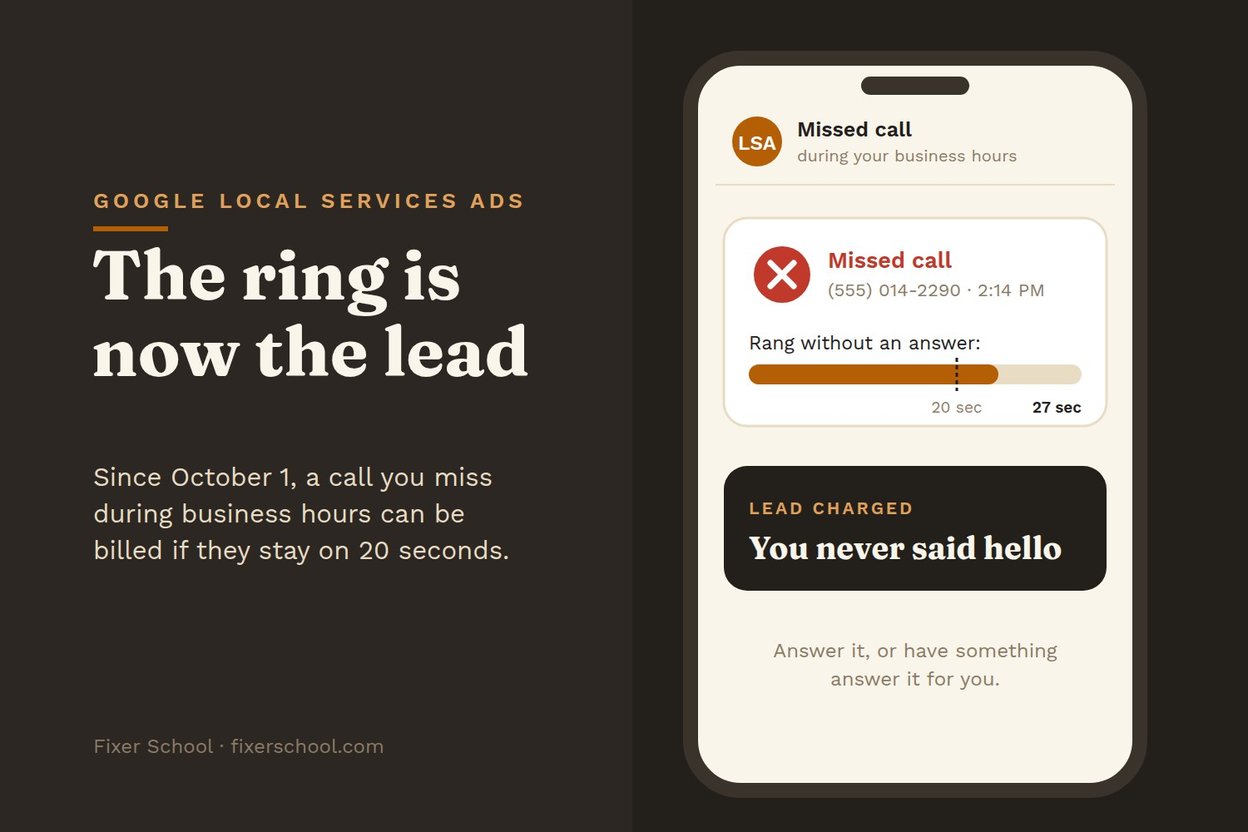
If you run Google Ads, know this: you can't target only AI Overview spots, you can't opt out of them, and Google Ads doesn't report them separately. Google's list of ads eligible to appear inside AI Overviews doesn't include Local Services Ads. If someone tells you where those ads always appear relative to the AI box, ask where they got it.
Here's how I'd split it:
- Keep doing what brings hiring calls: your Business Profile, reviews and the map pack. The data says that's still where most "who do I hire" searches end up.
- Test the research side cheaply: one or two honest pages answering cost and comparison questions, written from your own jobs.
- Go by booked jobs, not traffic. Only spend more when the calls and booked jobs go up.
When I was doing siding and handyman work, I took every call myself. The customers loved it, and it burned me out. Now the first answer a homeowner reads about price often comes from an AI box. When it names somebody, too often it's a middleman and not the person who'd actually do the work. You don't need to panic about the 88%, and you don't need to hand anyone a big check. Your knowledge from real jobs needs to be written down where Google can read it, and your phone needs to get answered when the hiring search comes.
Sources (15)
- Semrush: AI Overviews commercial modifiers study
- Search Engine Land: Google AI Overviews nearly double for commercial keywords
- Semrush: AI Overviews commercial search study
- Suff Digital: AI Overviews share of searches
- Whitespark: The prevalence of AI Overviews in local search
- Siana Marketing: AI Overview rate in construction and real estate
- 1-FIND SERVICES: Google AI Overviews and contractor searches
- Pew Research Center: Google users are less likely to click on links when an AI summary appears
- BrightLocal: Local AI visibility study
- LocalSeen: AI local visibility index
- Cheers: Home services AI visibility index 2026 (corrected)
- Google Search Central: AI features and your website
- Google Business Profile Help: How to improve your local ranking
- Google Ads Help: Ads in AI Overviews
- Local Service Stack: AI Overviews and local search for contractors