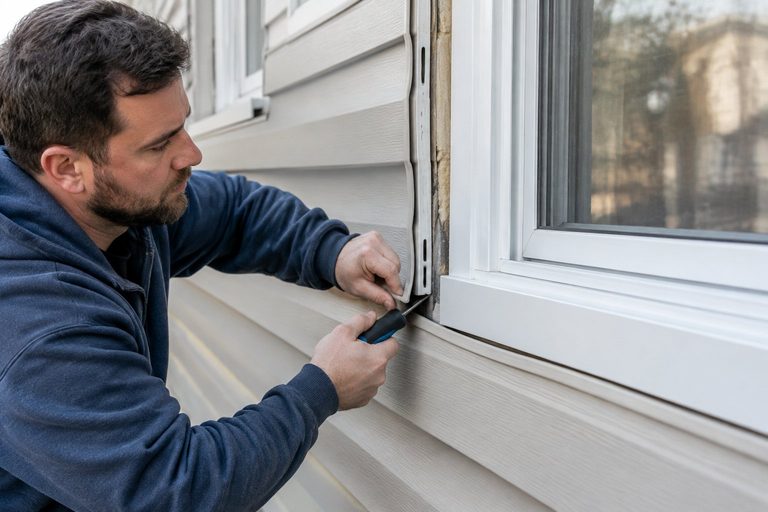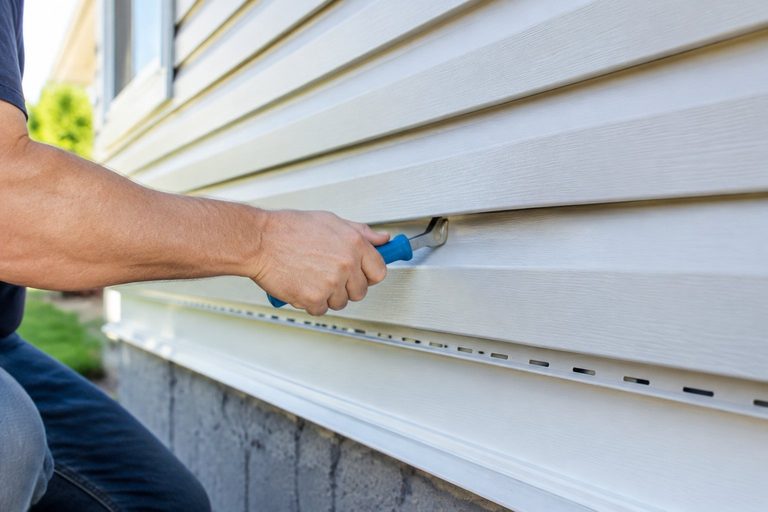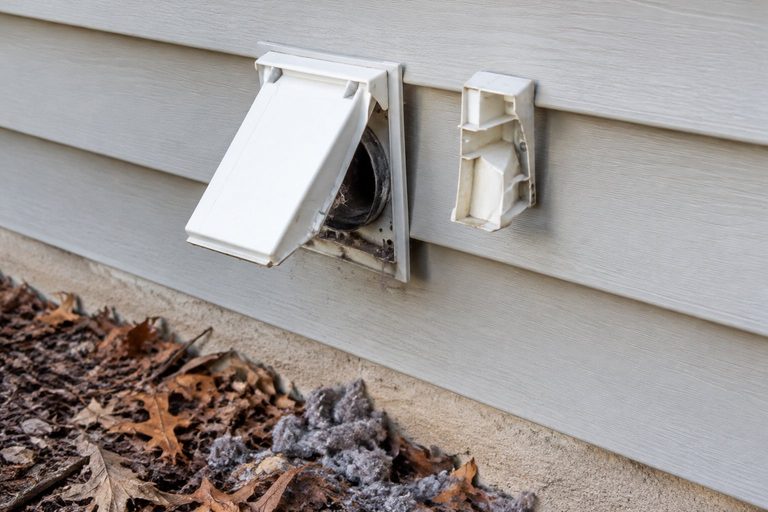
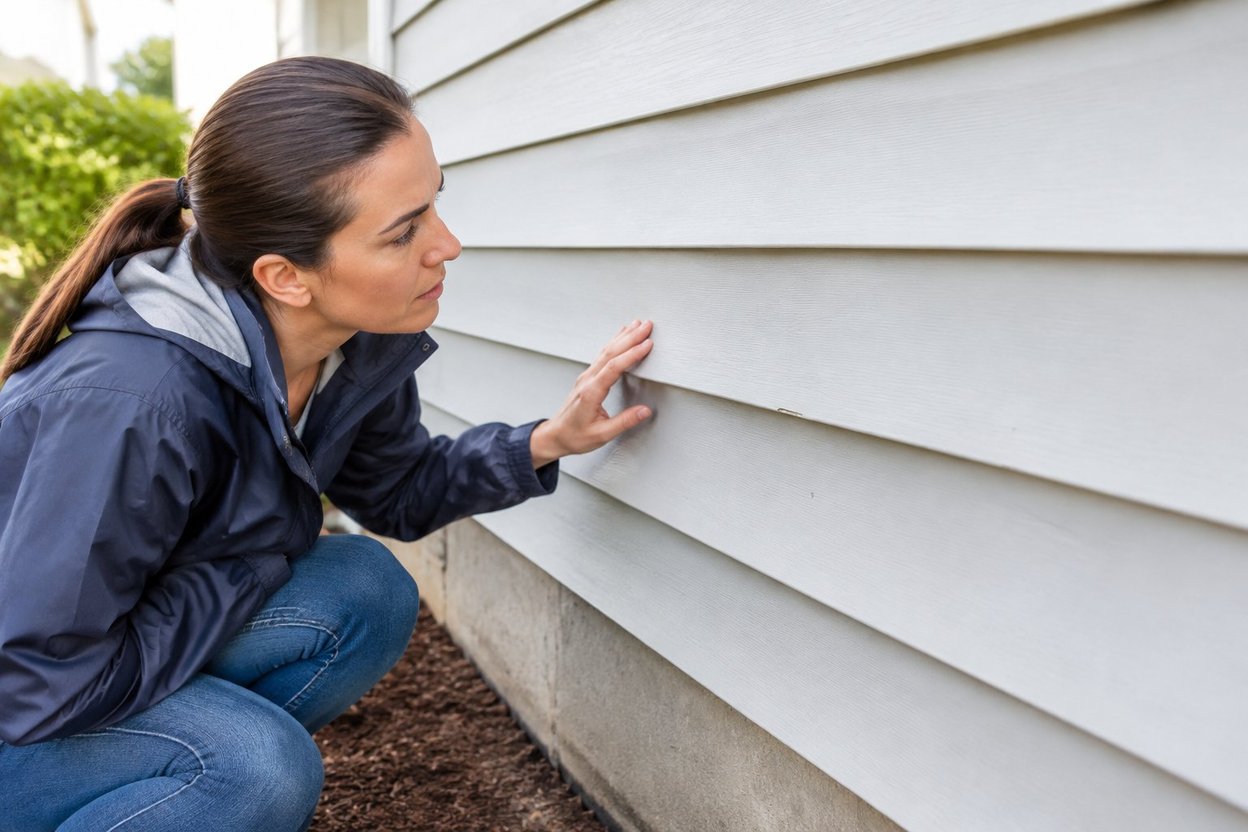
The storm came through, the hail was the size of golf balls, and now your phone is ringing. Someone you did a job for last spring wants to know if their siding is "ruined." Here's the quick answer. Hail doesn't dent vinyl. It cracks it, chips it, punches holes in it and breaks the locking edges. Most of that damage sits low on the panel, where you only see it if you look up from underneath. This guide covers what to look for, how to walk the house, what to photograph for insurance, and when it's not your job anymore.
What hail damage on vinyl looks like
Start with the material, because each one fails in its own way. Shelter Insurance puts it simply: vinyl siding cracks or breaks, aluminum siding dents or punctures, and wood siding dents or chips. If you're looking for dents on vinyl, you're looking for the wrong thing.
Hail damage on vinyl usually shows up as one of these:
- Splits running parallel to the siding. Trinity Exteriors describes these as cracks that follow the length of the panel.
- Half-circle fractures. These are curved cracks between a panel's valley and its ridge (Trinity).
- Half-circle chips at the bottom of a ridge. Trinity says chips commonly form there because the vinyl has little room to flex inward and soak up the hit. They're easiest to see when you look upward from below the siding.
- Cracks running up from the bottom butt edge. Buckshot Exteriors, writing for Wisconsin homeowners, tells people to check for exactly this.
- Punctures, chipped seam edges, and loose or partly detached panels. Suburban Construction lists all of these as inspection findings.
Here's a rough map of one lap of siding, top to bottom:
- Nail hem and lock at the top, hidden under the course above.
- Face, the flat or slightly curved part you see.
- Ridge, where the face bends outward. The bottom of the ridge is where chips hide.
- Valley, the recessed line between ridges. Half-circle cracks run between the valley and the ridge.
- Butt edge, the bottom lip that locks into the course below. Watch for cracks running upward from here.
Most people stand at eye level and look straight at the wall. From there the underside of every ridge is in shadow. Crouch down and look up.
Keep three questions separate
This is where most hail inspections go sideways, so it's worth slowing down. There are three different questions:
- Did hail hit this property?
- Is this panel actually damaged?
- Is this damage covered?
A dented downspout answers the first question. It says nothing about the second or third. A cracked panel answers the second, but only if you can rule out a lawnmower rock. The third question belongs to the policy and the adjuster, not you. If you keep these straight in your head and in your notes, you won't oversell the job and you won't miss real damage.
How to walk the house
Do it in this order.
1. Wait until it's safe. The Iowa Insurance Division's consumer guidance says to inspect only when it's safe to do so. That means no downed lines, no ladders in wind, and no climbing onto a roof you're not set up for. Siding inspection is ground work.
2. Walk all four sides, every time. Hail usually comes in on the wind, so the storm-facing wall tends to take the worst of it. But Suburban points out that overhangs, trees, neighboring buildings, porches and roof shapes can each shield part of a wall, which means damage can be patchy in ways you won't predict. Check every elevation anyway.
3. Change your angle. Suburban recommends looking at siding at an angle, because side lighting makes fractures and chipped edges easier to see. Late-day fall sun coming across a wall at a low angle works well. Then get low and look up at the ridges for those half-circle chips.
4. Slow down at the hot spots. Suburban names the areas under roof edges, outside corners, around windows, and storm-facing walls as the places to check closely for small cracks.
5. Check the collateral. United Services of Omaha recommends checking downspouts, downspout extensions, metal window and door trim, garage doors, and first-story gutters for dents. InterNACHI's inspection course calls air-conditioner fins easily damaged collateral evidence. Suburban adds damaged screens and shutters to the list.
6. Look at the ground. Suburban's checklist includes siding fragments in the yard. In late October the lawn may be under a layer of leaves, so check along the foundation and in the beds where pieces tend to land.
7. Check for exposed housewrap and new water stains. Suburban also lists exposed housewrap and water stains that show up after the storm. Iowa's guidance tells homeowners to check for interior leaks too, so ask whether anything has shown up on the inside walls.
Hail damage vs. look-alikes
Not every mark on a wall came from that storm. Trinity warns that rocks thrown by a lawnmower, backyard golf and kickball can leave damage that's hard to tell apart from hail when you look at one impact by itself. IBHS says installation damage, human-caused damage and weathering can all resemble hail. Here's how I'd sort what you find:
- Vinyl fracture (cracks, half-circle chips, holes). This is real damage to the panel. Check whether it fits a pattern across the exposed walls, or if it's one hit by itself near the lawn.
- Metal dent (gutter, downspout, trim, garage door). It's strong evidence that hail fell. It doesn't prove any particular vinyl panel is damaged.
- Spatter marks. IBHS lists spatter marks and dents on surrounding objects as signs that hail occurred. InterNACHI explains that spatter on aluminum vents is oxidation the hail knocked off, and that those marks oxidize again and fade over time. Photograph them early, and treat them as evidence the storm happened, not as damage.
- Scratches and slice-like marks. In its aluminum-siding section, InterNACHI says slice-like damage and scratches shouldn't be blamed on hail. Hail hits; it doesn't slice.
- One isolated impact. It could be hail. It could be a rock or a ball. Look for more impacts in the area.
- Loose panels, warping, stains, drafts. These are worth fixing, but they don't automatically point to hail. Old installation problems and heat can cause the same things.
Spatter on a vent and a cracked panel on the same wall tell a better story together than either one alone.
How bad is it?
Size isn't everything. Shelter says jagged hailstones and strong wind can both make the damage worse, and that hail diameter alone doesn't describe the impact. The siding's age matters too. Suburban notes that older vinyl, after years of sun and seasons changing, may be less flexible than when it went up.
InterNACHI's course gives a good example from one neighborhood hit by 1½ to 2½ inch hail. The vinyl took extensive damage, while nearby homes with hardboard siding mostly lost some paint. Same storm, different results. Use that as a picture of how hail behaves, not as a rule about what size cracks vinyl.
Then sort what you found into two groups. Suburban separates shallow marks that only affect looks from impacts that fracture a panel or damage its locking edge. It also notes that a fracture can run past the mark you can see. A crack at the butt edge can travel further than it looks, and a broken lock means the panel can work loose.
Don't caulk cracks. Suburban says cracked siding should normally be replaced rather than covered with caulk, because a surface patch doesn't bring back the panel's strength or fix a damaged locking edge. A crack is a possible path for water, so replace the piece. That doesn't mean there's rot behind every crack. It means you don't leave it open going into winter.
This is the part of the job that suits a repair business. Pull the damaged course, slide a new panel in, lock it, nail it, done. Replacing a panel or two is often a short job with a handful of tools. My average ticket across my repair mix was about $350, and that's my number, not a promise for your area. Hail jobs vary a lot more than that, depending on how many walls got hit and whether matching panels can still be found.
Photos and notes for the insurance claim
Good documentation protects the homeowner and protects you. The state regulators in hail country spell it out.
The Iowa Insurance Division recommends photos and videos, a detailed written description of the damage, and receipts for any materials bought to prevent further damage. Nebraska's Department of Insurance recommends a written list of affected items, and names windows, shutters, siding, fascia, ceilings and satellite dishes specifically. Nebraska also says that if repairs have to happen before the adjuster arrives, the damage should be photographed or videotaped first, and damaged items should be kept for the adjuster to see before anything gets thrown out. If you tarp a hole or pull a shattered panel, bag the pieces and leave them with the homeowner.
A simple wall-by-wall record keeps it organized. Copy this for each elevation:
- Wall: front / back / left / right (note which way it faces)
- Wide shot: the whole wall, from far enough back to see it all
- Mid shot: each damaged area, with a window or corner in frame so you can tell where it is
- Close-up: each crack, chip or hole. Shoot one from below the ridge looking up.
- Collateral on this side: gutters, downspouts, trim, screens, shutters, vents
- Ground: any siding fragments
- Interior: any new stains on the inside of this wall
- Questions for the adjuster or inspector: anything you're unsure about
For the AC unit, InterNACHI recommends shooting from opposite corners, which shows all four sides in two photos.
On marking: InterNACHI warns that chalk makes impact marks on metal easier to see but also makes the damage look bigger than it is. If you mark anything, take a photo before and after, and say so. Inflated-looking photos hurt your credibility with adjusters, and in this trade you'll meet the same adjusters again.
Coverage: what you can and can't tell the homeowner
Stick to what's true everywhere. Progressive says homeowners insurance may cover hail damage to siding, minus the deductible, and that standard policies typically cover hail, but a separate hail deductible can apply. Iowa's regulator warns that some policies have hail exclusions, separate hail deductibles and deadlines for filing claims.
So the honest answer to "will insurance pay for this?" is: read your policy and call your agent. Don't promise a full re-side and don't name a filing deadline. Both depend on the policy. Iowa also recommends that homeowners be there for the adjuster's inspection, point out every affected area, and get estimates from at least two registered contractors. If someone asks you to be on site for the adjuster, your wall-by-wall record is what you bring.
When to call in a pro, or someone besides you
If you're the homeowner's repair guy, you're probably the first pro they call. Even so, part of being a good one is knowing when to hand the job off:
- The roof. If there's hail damage on the siding, the homeowner should get the roof looked at. That's a roofer's job, done from the roof. Refer it out.
- Interior leaks or water stains. That moisture is coming in somewhere. Find the source before you call it a siding job.
- Whole elevations shattered. When most of a wall is broken, matching becomes the main problem, and the claim usually gets bigger. Feldco, a siding company, argues for a professional inspection even when the damage isn't obvious and warns against inexperienced repairs. That's a fair point when a lot of the house is involved.
- Coverage disputes. You're not the adjuster. Document, explain what you see, and let the policy questions go to the agent.
One caution about the busy weeks after a storm. In an old InterNACHI forum thread, an inspector warned about door-to-door storm sellers and mechanical damage being called hail. That's one person's opinion, but it's a reputation every hail market eventually gets. You don't fix that by knocking on more doors. You fix it by calling a lawnmower rock a lawnmower rock. If you plan to take on storm work, check your local licensing, registration and insurance rules first. Some places have their own rules for this, and they're covered elsewhere on this site.
The timing matters this time of year. A cracked panel left open from late October to Thanksgiving goes through a lot of cold, wet weather. Get the photos done this week and the replacement on the schedule before the freeze.
FAQ
Can small hail damage vinyl? It can. Shelter says hail size alone doesn't describe the impact, since wind and jagged stones make a difference, and Suburban notes older vinyl can be less flexible. There's no single size that guarantees damage, so inspect after any real hail.
Why is only one wall damaged? The storm-facing side usually takes the most, and Suburban explains that trees, overhangs, porches, neighboring buildings and roof shapes can shield other areas. Damage on one wall fits with hail. Check every wall anyway.
Do dented gutters prove the siding is damaged? No. Gutter and downspout dents show that hail fell on the property. Whether a vinyl panel is cracked is a separate question, and you answer it by looking at the panel.
Does insurance pay for full siding replacement? It depends on the policy. Progressive says standard policies typically cover hail minus the deductible, and Iowa warns about exclusions, separate hail deductibles and filing deadlines. Nothing guarantees a whole-house replacement.
Can I just caulk a hail crack? Suburban says to normally replace cracked siding, because caulk doesn't restore the panel's strength or a broken locking edge.
Sources (13)
- Shelter Insurance: Hail Damage to Your Home
- Trinity Exteriors: How to Identify Vinyl Siding Hail Damage
- Suburban Construction: What Does Hail Damage Look Like
- Suburban Construction: Can Hail Damage Vinyl Siding? (Quad Cities Guide)
- Buckshot Exteriors: Hail Damage on Siding
- United Services of Omaha: How to Check Your House for Hail Damage
- InterNACHI: Hail Damage Inspection Course, Part 3 (PDF)
- IBHS: Do I Have Hail Damage? (PDF)
- InterNACHI Forum: Hail damage to siding
- Feldco: Hail Damage on Siding
- Iowa Insurance Division: Consumer Connection, Hail Claims
- Nebraska Department of Insurance: Hail Damage (PDF)
- Progressive: Does Home Insurance Cover Hail Damage?