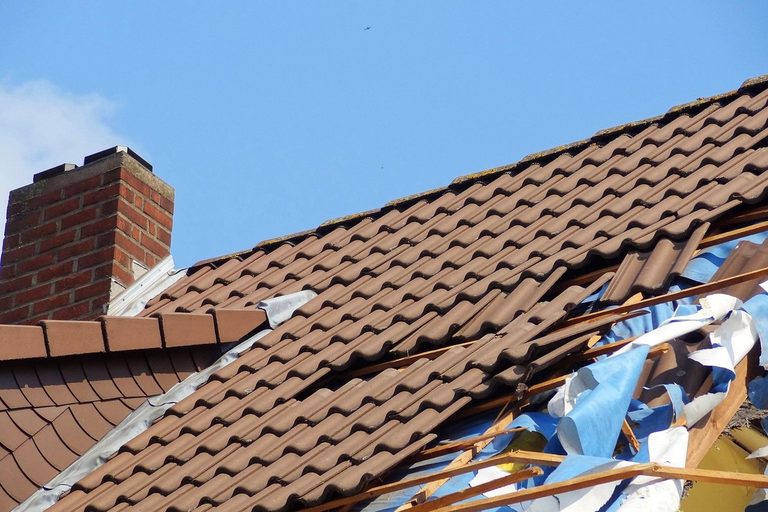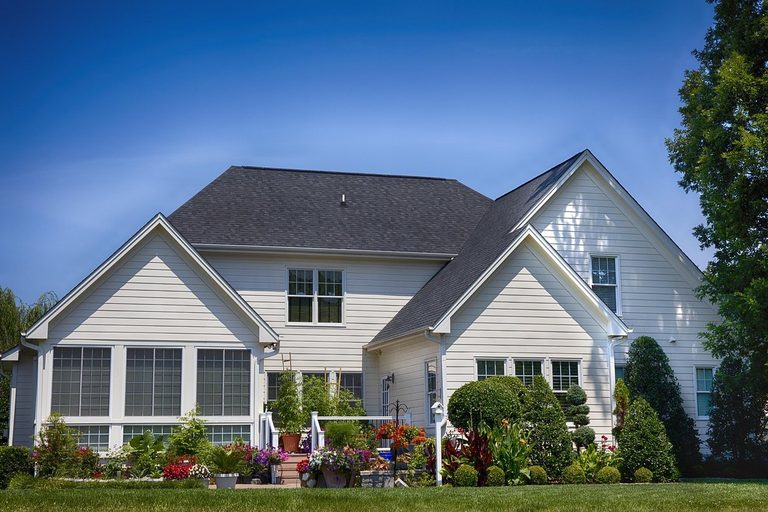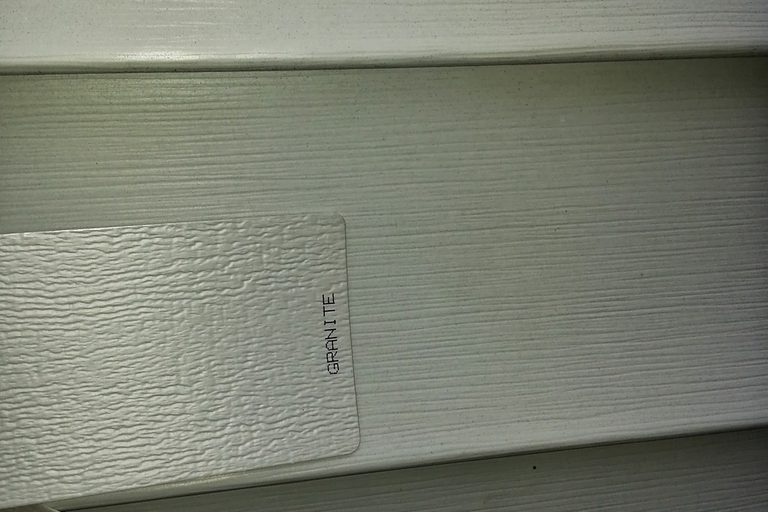
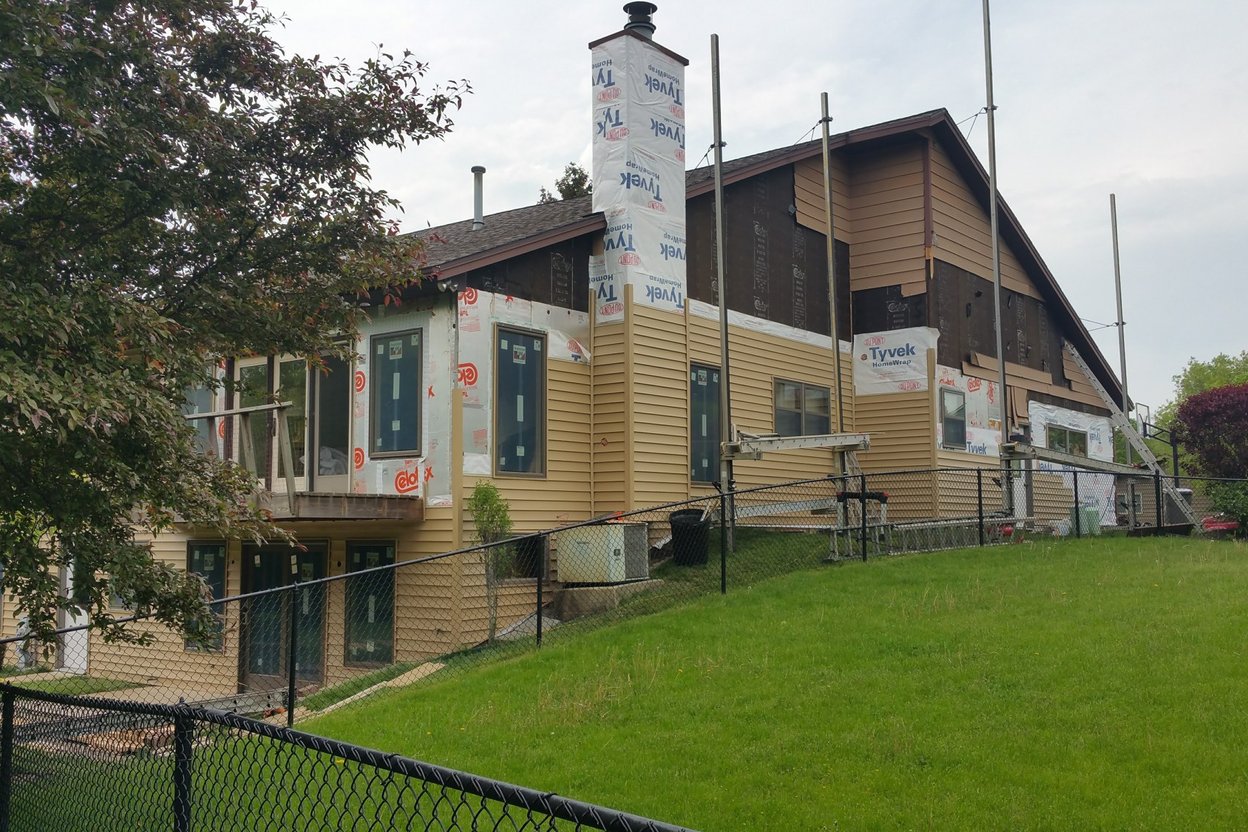
You're standing in a driveway looking at a wall of old aluminum siding that hail has dented and punched through. The homeowner holds out the adjuster's estimate. It pays for one wall. You already know you can't buy that siding anymore, so any patch will stand out from the street. Most of the time, the way the claim grows past one wall is a written letter from a supplier saying the product is discontinued, read alongside Ohio's matching rule. It doesn't always work, but it's the strongest argument the homeowner has.
The short answer
When hail damages aluminum siding that is no longer made, nothing you put on the house will match what's left. New panels next to 30-year-old faded ones look like a repair even if the color name is the same.
Ohio has a rule for this. If a covered loss means replacing an item and the new one doesn't match the old in quality, color or size, the insurer "shall replace as much of the item as to result in a reasonably comparable appearance." That wording doesn't say "the whole house." It says enough to make it look right.
That is where the letter comes in. A written statement from a supplier, distributor or manufacturer says the profile and color are discontinued and there's no equivalent available. With that, "we'll pay for the north wall" gets much harder to defend. The letter turns "I think it won't match" into proof that it can't.
I have to be clear about one thing. Nothing here is guaranteed. Most Ohio courts have accepted a reasonable match instead of full replacement, and each case turns on its own facts and its own policy. The April 2026 hail in Northeast Ohio is a good example of when this matters.
Why Ohio hail makes this common
On Wednesday, April 15, 2026, hail hit parts of Northeast Ohio, and the Solon area took a lot of it. Cleveland19 reported two-inch hail, the first that size in Cuyahoga County in six years. Windows broke and siding was punctured. One roofer said he had more than 1,000 inspection calls.
The same report said something every repair guy should hear: insurers sometimes push back on full replacement and offer to replace only a section or two.
Old aluminum siding is still on a lot of Ohio houses. It holds up for decades, but hail dents it like a car hood, and the exact profile and color on a given house often went out of production years ago. If you're still seeing spring hail damage this fall, before the cold sets in, you'll run into this question. The homeowner will ask you whether insurance has to pay for the whole house, and you'll want a straight answer.
What Ohio's rule says
The rule is Ohio Administrative Code 3901-1-54. The matching language is in paragraph (I)(1)(b), and the current version took effect February 14, 2022.
Get the wording right, because people mix it up. Ohio says "reasonably comparable appearance." "Reasonably uniform" is Kentucky's wording. If you or the homeowner quote the wrong state's phrase in a letter, the other side will notice.
Here's what the rule doesn't do. It doesn't give a homeowner a private right to sue. Nobody can walk into court and say "the insurer broke 3901-1-54, pay me."
Courts still use the rule anyway. In Cinnamon Ridge Condominium Assoc. v. State Farm (S.D. Ohio, May 16, 2024), a federal court treated it as evidence of how the industry does things when it read the policy's term "comparable material." So the rule ends up inside the argument about what the policy means, even though it can't be sued on directly.
The other side of it is that most Ohio courts have held a reasonable match is enough, and full replacement isn't automatic. A "reasonable match" claim has to show that a reasonable match isn't possible. That's why the discontinued letter matters so much. It's the piece of evidence that says close enough doesn't exist.
What the letter has to say
No rule says who has to write it or what form it takes. This is common practice, not law. But a vague letter is close to useless, so here's what a good one looks like.
Who sends it. A siding supplier, distributor or the original manufacturer, on their letterhead, signed and dated. You're the repair contractor, so a note from you saying "it's discontinued" counts as your opinion. A note from the people who sell or made the product carries more weight.
What it names:
- The profile, for example the panel style and exposure
- The gauge, or metal thickness
- The color name and, if known, the color code
- The manufacturer and product line, if they can be identified
- The date or approximate year it was discontinued
- A plain statement that no equivalent product is in stock or available to order
A letter that only says "aluminum siding is hard to find" doesn't help. A letter that names the product, the color and the year it was dropped does.
What goes with it. The letter is one piece of a package:
- A matching report. Carriers often use ITEL-type services. ITEL says its matching product will "identify the closest available match for roofing, siding, or flooring materials to enable a repair." Note the word "closest." If the closest match is visibly different, put the report next to your photos and let it show that.
- Photos of every wall, not just the damaged ones. Take wide shots that show how a new panel would sit next to the old ones, plus close-ups of the dents and punctures.
- The adjuster's written position. Get it in writing. A verbal "we only cover one elevation" can't be appealed.
One more thing: read the policy. Some carriers sell matching coverage that specifically includes obsolete or discontinued materials. Acuity is one that advertises it. Some policies may exclude cosmetic-only damage to siding. The wording in that specific policy can matter more than anything else here.
What courts did with "can't buy it anymore"
The two cases people point to are both from outside Ohio, so Ohio courts don't have to follow them. Ohio courts can find them persuasive, but nothing forces them to.
Windridge of Naperville Condominium Assoc. v. Philadelphia Indemnity (7th Cir., Aug. 7, 2019). A May 2014 hail and wind storm damaged aluminum siding on two sides of the buildings. Matching siding was no longer available. The court affirmed that the insurer had to pay to replace the siding on all sides. The court found the policy unclear about what counted as the damaged property, and under Illinois law that kind of uncertainty goes to the insured. This is an Illinois case, and the facts look a lot like the scene in that driveway.
Cedar Bluff (Minnesota Supreme Court, 2014). Hail-damaged siding had to be replaced with "comparable" material, and the result was replacing all the siding to get a reasonable color match. This is Minnesota law, not Ohio's.
The Ohio cases have mostly gone the other way:
- Wright v. State Farm (6th Cir.) declined to stretch Ohio's rule to a full roof replacement without special circumstances. It also said the insured needs evidence beyond their own opinion that a repair wouldn't look comparable.
- Zinser v. Auto-Owners (Ohio 12th District) held that after a wind loss the insurer didn't have to replace the siding on the whole building.
Look at what Wright asks for: evidence beyond the homeowner's opinion. A specific discontinued letter, a matching report and photos of every wall are that evidence. They don't make the claim a sure thing, but they meet that standard.
If the carrier still says no
The homeowner appeals in writing. They ask the carrier to quote the exact policy language it's relying on to limit the repair. Then they send the letter, the matching report and the photos again with that appeal.
If that goes nowhere, they can file a complaint with the Ohio Department of Insurance Consumer Services, either online or by calling 1-800-686-1526. The mailing address is 50 West Town Street, Third Floor/Suite 300, Columbus, OH 43215. A confirmation letter usually comes within about two weeks, and the review usually takes about 30 days.
Know where your job stops. You fix siding. You don't argue coverage. In a lot of places, negotiating a claim for the homeowner is a licensed activity, so check what your state allows. The homeowner makes the case. A public adjuster or an attorney can help them. Your part is clean documentation, an honest repair estimate and a good relationship with the supplier who can write that letter. That's work you can do well, and it's how you get referrals from neighbors.
Sources (12)
- Ohio Adm. Code 3901-1-54
- Ohio matching law (Merlin Law Group blog)
- Ohio court determines that Ohio law requires matching (Merlin Law Group blog)
- A reasonable match is often, but not always, acceptable under Ohio law (Isaac Wiles)
- Hail slams parts of Northeast Ohio, damaging homes in Solon area (Cleveland19)
- ITEL Now (Nearmap)
- What is matching siding coverage? (Acuity)
- Replace all siding (Axley)
- Insurer must pay to replace all siding on hail-damaged condominium buildings (Business Insurance)
- Cedar Bluff opinion (Minnesota Supreme Court)
- How to file a complaint with the Ohio Department of Insurance (Merlin Law Group blog)
- Ohio Department of Insurance saved Ohioans $33M in 2019 (Ironton Tribune)