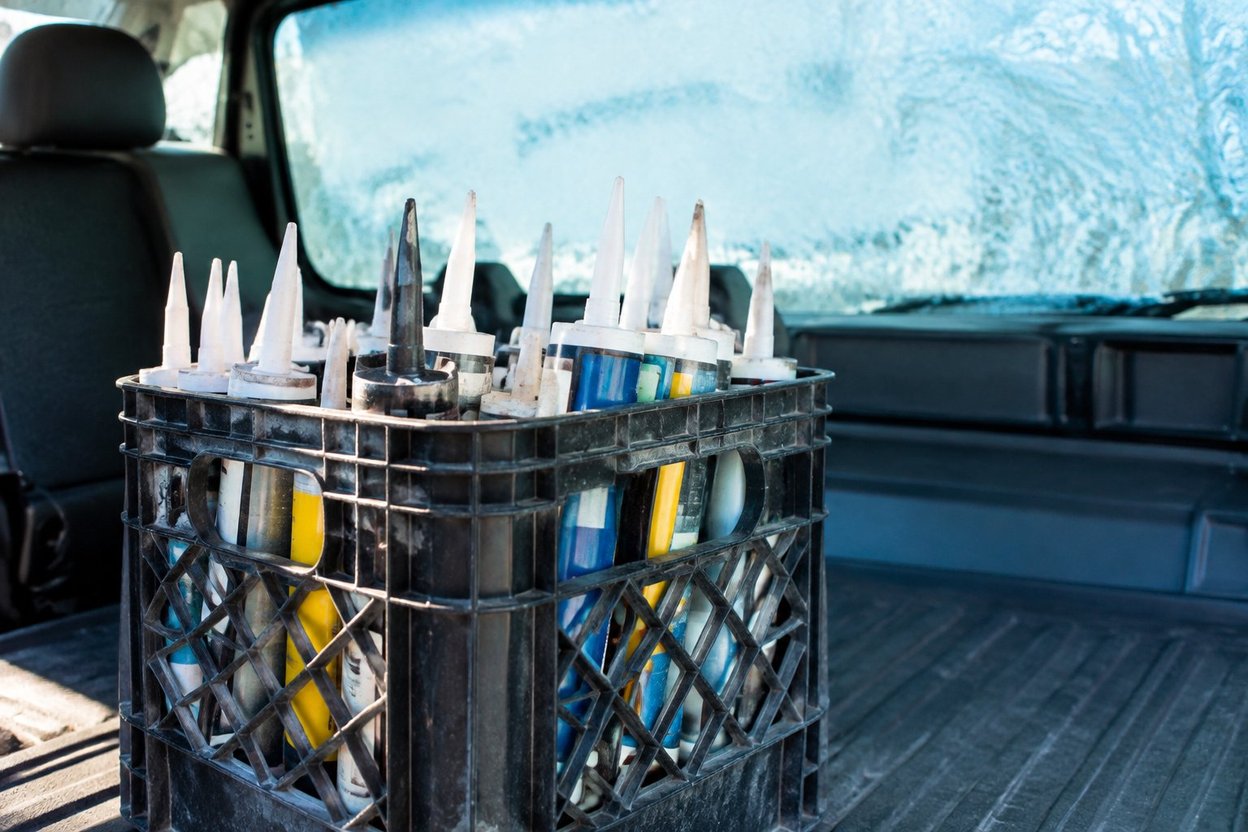
You come out to the truck on a frosty October morning with a 1-hour repair on the schedule. You grab a tube of caulk from the bin behind the seat and it barely moves when you squeeze the gun. Here's the short version. Water-based caulk and some adhesives can be ruined by a night below freezing, so they come inside with you. Vinyl siding stock can stay in the truck. You just have to let it warm up before you cut or nail it.
The short answer: what needs to come inside
Sort what's in your truck into two piles.
Comes inside every night: - Water-based caulk, especially acrylic latex - Construction adhesive, unless the label says it handles freezing - Any sealant whose label lists a storage range that tonight's low will drop below
Can stay in the truck: - Vinyl siding panels, J-channel, trim and accessories - Nails, snap lock punch, zip tool and the rest of your hand tools
Water-based caulk left below freezing can become useless (PK Supplies). One electrical contractor wrote on a trade forum that he brings his caulk and tape inside overnight and keeps them in the cab or in his pockets on cold days, because they freeze and stop working (ECN forum). Other trades deal with the same problem.
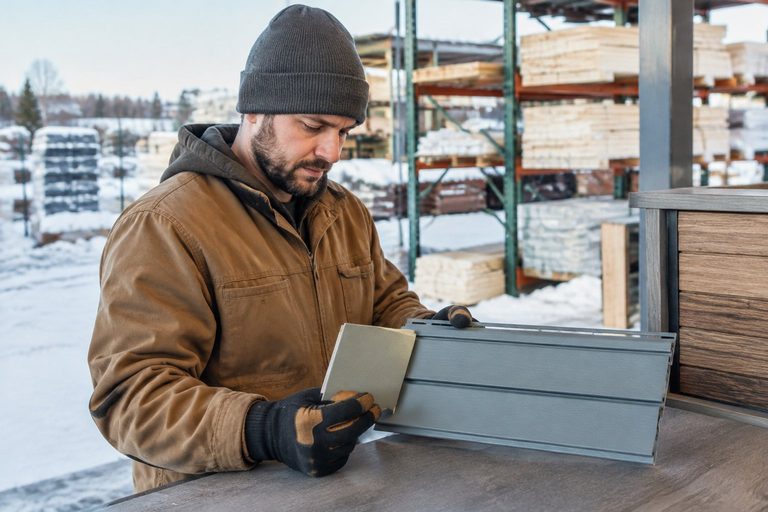
Vinyl is different. Cold doesn't seem to hurt a panel sitting on the rack. The trouble starts when you cut or nail it cold, because cold vinyl is brittle. Your tubes need protecting overnight. Your panels need warming up before you work them.
What freezing does to caulk and adhesive
Most caulk and adhesive labels give a comfortable temperature range of roughly 40 to 90°F. Here are a few examples:
- DAP Alex Plus (acrylic latex plus silicone): the 2025 data sheet says to apply it between 40 and 100°F. It also says not to apply it if rain or freezing temperatures are expected within 24 hours. For storage it only says to keep it away from extreme heat or cold (DAP TDS).
- Sashco Big Stretch: the instructions say to store it at 40 to 90°F.
- Loctite PL Premium: Henkel's data sheet says the adhesive should be above 41°F and below 95°F for best performance (Henkel TDS).
Acrylic latex is the type most likely to be damaged by freezing. It's mostly water, and freezing breaks it down. Silicone handles cold better (thedonutwhole.com). That matters because cheap latex caulk is what tends to pile up in the truck bin.
Some products are sold as cold-tolerant: - Sashco Lexel: Sashco says it won't freeze in storage and is freeze-thaw stable. - Sashco Through the Roof: Sashco markets it for application from 0 to 120°F (JLC).
Those are the manufacturer's claims. Other brands of caulk and adhesive vary, and different products from the same brand can vary too. Read the label on the exact tube you're carrying. If the label doesn't say how the product handles freezing, call the manufacturer or assume it doesn't.
Siding stock in the cold
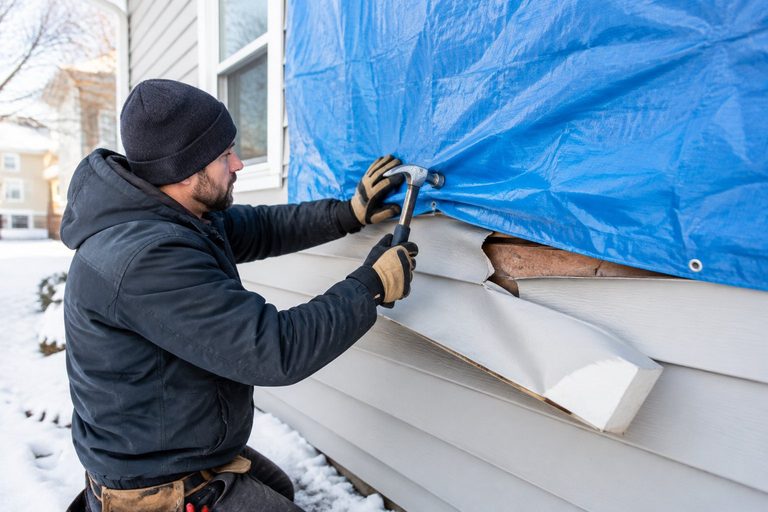
Leaving vinyl in the truck overnight is fine. The risk comes the next morning when you work it cold. Cold vinyl gets brittle and can crack when you nail it. Contractors set their own cutoffs. One Minneapolis installer stops installing around 20°F, and a Wisconsin contractor uses 0°F (New England Today, Fixr). They disagree on the exact number, but they agree that cold changes how vinyl handles.
Two rules from the Vinyl Siding Institute's installation guidance, as summarized by Polymeric Exteriors:
- Below 40°F, leave a wider gap. Increase the minimum clearance at openings and stops from 1/4" to 3/8". Vinyl installed cold will expand when it warms up, so it needs the extra room.
- Cut slowly. A fast cut on cold vinyl is how you crack a panel you just paid for.
If you can, warm the panels before you work them. Put them in a garage, a heated shop or your basement the night before. Fence installers recommend bringing PVC boards into a heated space 24 to 48 hours before cutting (All Season Fencing). That advice is for fencing, not siding, but the idea carries over. On a repair, it's easy. You're usually replacing a few panels, not a whole wall, so bring in the pieces for tomorrow's job when you bring in your tubes.
Truck and trailer tricks
Take the tubes inside. This is the cheapest fix and it works best. A milk crate of caulk and adhesive by the back door costs nothing.
A closed truck or trailer helps somewhat. One contractor on a Fine Homebuilding forum estimated that a closed, fairly airtight trailer stays about 10°F warmer than outside overnight, and that some old blankets over the stock might add another 10°F. By that estimate, a 20°F low might be survivable (Fine Homebuilding forum). That's one person's experience, not a tested number. Don't rely on it for a single-digit night.
Use a cooler with hand warmers. In Fine Homebuilding, a contractor describes his setup: 1. Keep the caulk indoors overnight. 2. In the morning, move the tubes into an insulated cooler with disposable hand warmers. 3. Slide foam pipe insulation (2-3/8" inside diameter) over the gun barrel and tuck up to four hand warmers inside it.
He says this keeps caulk usable for six to eight hours. That covers a full day of repair jobs.
Try a heated bag. JLC reviewed a plug-in insulated bag with a heating element. It warmed seven tubes of glue that had spent the night in a truck in about 10 minutes. If you run your truck between jobs anyway, it's worth a look.
Switching to cold-rated products and testing a tube
Once the weather turns for good, around Thanksgiving in a lot of the vinyl belt, it can make sense to carry some cold-rated products alongside your usual ones:
- Sealant: Lexel or Through the Roof, according to Sashco's claims above.
- Adhesive: Loctite PL Premium Max is listed by retailers for application down to 10°F and on wet or frozen surfaces (Lowe's). It still cures more slowly in the cold.
These products usually cost more per tube. Whether that's worth it depends on how many cold mornings you work and how often you forget to bring tubes inside.
If a tube froze anyway: - Let it warm up slowly at room temperature. Don't microwave it. - Run a short test bead on scrap before you use it on a customer's wall. - If it comes out thick, lumpy or stringy, throw it out (thedonutwhole.com).
A tube costs a few dollars. A callback on a failed seal costs you a trip, an hour and some of the customer's trust.
A simple nightly routine
Once the forecast starts showing lows near freezing, often around Halloween in northern states, do this every evening:
- Check tonight's low. If it's under 40°F, the tubes come inside.
- Bring in the caulk and adhesive crate. Include any partly used tubes in the gun.
- Bring in tomorrow's panels if you have room, or at least cover the stock with blankets.
- Charge or stock the warmers. That means hand warmers in the cooler or the heated bag plugged in.
- In the morning: load the tubes into the cooler, put the foam sleeve on the gun, and use a 3/8" gap and slow cuts if it's still under 40°F.
It takes about five minutes, and it saves you from throwing out frozen tubes and cracking cold panels.
Sources (13)
- PK Supplies: Guide to Cold-Weather Caulking and Sealing
- Electrical Contractor Network forum
- DAP Alex Plus Technical Data Sheet
- Henkel Loctite PL Premium Technical Data Sheet
- JLC: Avoiding Winter Caulking Woes
- Lowe's: Loctite PL Premium listing
- Polymeric Exteriors: Installation Tips and Tricks
- New England Today: Don't Install Vinyl Siding in Cold Temperatures
- Fixr: Best Time of Year to Install Vinyl Siding
- All Season Fencing
- Fine Homebuilding: Cold-Weather Caulking
- Fine Homebuilding forum: Cold Weather Caulking
- The Donut Whole: Can Caulk Be Stored After Opening?