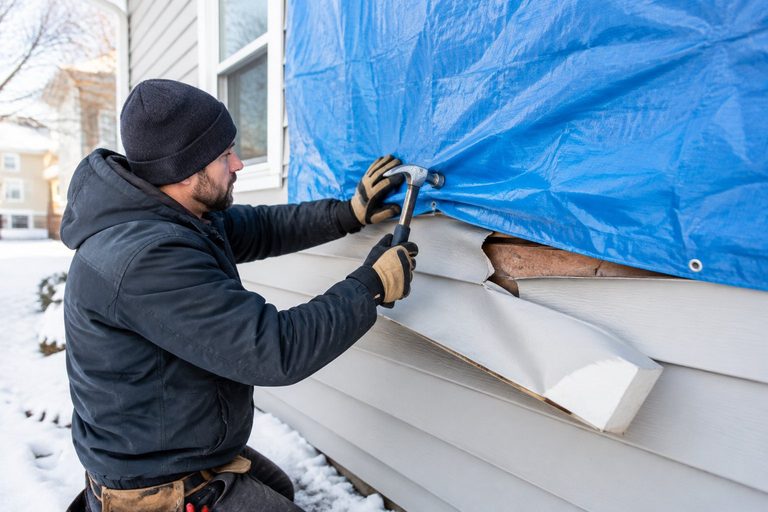


Picture yourself at the supply counter. You quoted a job weeks ago, and now the J-channel and the box of siding cost more than the number in your head. You still do the job. You just make less on it. You can stop that from happening by setting your prices once a year, in December, before the first January call comes in. Pull this year's real costs, do the math for the margin you want, raise your prices to match, and tell customers clearly.
The short answer: reprice once a year, in December, from your real costs
Pick one evening in December, after Thanksgiving and before the new year. Sit down with this year's receipts, invoices and mileage log. Don't use what you think things cost. Use what they actually cost.
The goal is simple. Your prices need to cover three things:
- What your materials, truck and overhead cost you now, not last January.
- A raise for you. Inflation shrinks your wage too.
- A profit margin you picked on purpose.
Do this once a year so your customers aren't getting a new price every month. December is a good time because the slow season gives you room to think, and many suppliers start new price lists on January 1.
The worst way to learn you're underpriced is a bad month. By the time the bank account shows it, you've already done a season of jobs at last year's numbers.
This year makes the December check matter more than usual. Vinyl prices didn't go up once in 2026. They went up several times. If you priced in January and never looked again, you're probably behind.
What moved in 2026
Here's what the big vinyl makers announced this year:
- Alside, round 1: 2–4% on vinyl siding, soffit and accessories, effective March 8, and 4–6% on ASCEND composite cladding.
- Alside, round 2: another 5% on vinyl siding, soffit and accessories, effective May 1. The letter said polyvinyl costs were up about 17% and polypropylene about 42% since late February.
- Alside, round 3: another 6% on vinyl siding, soffit, accessories, shakes and scallops, effective August 10. ASCEND went up 3%.
- Westlake Royal: 5–7% on all vinyl siding, insulated siding, shake, soffit, accessories, shutters, vents and blocks, effective August 24. It cited raw material, fuel and energy costs.
- Cornerstone Building Brands: 5% on all vinyl siding and accessories, injection-molded products and PVC trim, effective September 1. It cited "significant and sustained inflationary pressure."
If you buy Alside and all three increases hit the items you use, the stacked total is roughly 13 to 16% since winter. That's my own math from their posted percentages.
Fiber cement was quieter. James Hardie raised prices on June 29, but only on its DREAM, Milled Artisan and Artisan Trim lines. Hardie called it "a measured approach," not a broad increase.
The general economy moved too. The September consumer price index was up 3.7% over 12 months. Energy was up 20.4% and gasoline 34.2%. If you drive a truck for a living, you already felt that.
Use these notices as a heads-up, not as your numbers. What your supplier charges you depends on your branch, your account and what you buy. Your own invoices are the real answer.
Know your real costs
For a repair business, real costs come in five buckets.
Materials. Take the items you buy most, like your usual siding profiles, J-channel, starter strip, trim coil and fasteners. Find a January invoice and a recent one for the same items, then compare line by line. That gives you your own increase, which beats any national average.
Truck. Fuel, insurance, tires, repairs and the payment all add up. The IRS standard mileage rate is a good gut check. For 2026 it started at 72.5 cents a mile. Then the IRS made a rare mid-year change and raised it to 76 cents for miles driven on or after July 1, because fuel prices went up. If you've been pricing your truck at something like 40 cents a mile, that rate tells you you're probably low. You don't have to use the IRS number. Just make sure your own number holds up next to it.
Tools. Blades, a zip tool that walks off, a ladder that has had enough. Add up what you replaced this year.
Insurance and fixed overhead. Liability, phone, software and anything you pay whether you work or not. Your rates and requirements depend on where you work. That has its own article.
Your wage. Pay yourself first, at a real hourly number, before profit. If the business only works when you pay yourself nothing, it doesn't work.
Spread the overhead across the jobs you actually did this year, not the jobs you hoped to do. That gives you a per-job overhead figure to use in the math.
Do the math: markup vs. margin
This is where many tradesmen lose money without noticing. Markup and margin are different numbers.
- Markup % = (price − cost) ÷ cost × 100
- Margin % = (price − cost) ÷ price × 100
Markup is measured against your cost. Margin is measured against the price. So a 20% markup is only a 16.7% margin, and a 30% markup is a 23.1% margin. The formula is margin = markup ÷ (1 + markup). On a bigger job, $20,000 in cost sold for $26,000 is a 30% markup but only a 23.1% margin.
To price for the margin you want, use this:
Price = cost ÷ (1 − target margin)
Here's a worked example for one small repair. The numbers are made up to show the math. Use your own.
- Materials: $70
- Truck, 30 miles at 76 cents: about $23
- Your wage, 2 hours at $50: $100
- That job's share of overhead and tools: $25
- Total cost: $218
With a 20% markup, you'd charge about $262. That's a 16.7% margin.
If you want a 30% margin, the price is $218 ÷ 0.70 = about $311. Round it to $315.
That's a $53 difference on one small job. Multiply it across a season of repair calls and it adds up to real money.
For a frame of reference, my average ticket on my mix of repairs was about $350. That's my number, not a promise for your zip code.
Your margin has to cover profit on top of overhead you haven't already put into cost. If your overhead is high and your markup is thin, you can stay busy all year and end up with nothing.
Tell customers and handle old quotes
New prices only help if they show up in your estimates without confusing anyone.
Put a good-through date on every estimate. Something like "Price good for 30 days" works. With prices this year moving several times in a few months, an open-ended quote is a risk you don't need to take.
Say plainly why prices moved. You don't need to apologize or give a speech. Try something like: "Vinyl went up three times this year, and fuel is up. My prices for next year reflect that." Most homeowners have seen the same thing at the gas pump.
Keep the paper. Save your supplier price letters and your receipts. If a customer asks why, you can show them. They also help you next December.
Old quotes are a different story. If a customer already signed a fixed-price quote, you generally carry the material increase unless the contract has an escalation clause. An escalation clause lets the price move if a set event happens, like a material index rising by a certain percentage. The time to add one is before you sign next year's work, not after.
Rules on written contracts, estimates and price changes are different from state to state. Check yours, and if you're unsure, ask a local attorney.
A December checklist
- Pull January and recent invoices for your 10 most-bought items and compare prices line by line.
- Read any supplier price letters you got this year and ask your branch if anything is scheduled for January.
- Total your truck costs and check them against the IRS mileage rate.
- Add up tools, insurance and fixed overhead, then divide by the number of jobs you actually did.
- Set your own hourly wage and give yourself a raise.
- Pick a target margin and price with cost ÷ (1 − margin).
- Update your price sheet, estimate template and good-through date.
- Look at your contract wording on escalation and ask an attorney if needed.
- Write a short, plain line explaining the change to customers.
- Put next December's pricing night on the calendar now.
Sources (16)
- Alside: Siding Pricing Update (March 2026)
- Alside: Siding and Metals Price Increase Announcement (May 2026)
- Alside: Pricing Update, Siding, August 2026
- Cornerstone Building Brands price increase, 9/1/26 (ABC Supply)
- Westlake Royal price increase, 8/24/26 (ABC Supply)
- James Hardie price increase, 6/29/26 (ABC Supply)
- BLS Consumer Price Index news release
- Trading Economics: US monthly inflation
- IRS: 2026 business standard mileage rate 72.5 cents
- UHY: IRS raises standard mileage rates for second half of 2026
- Journal of Accountancy: IRS raises standard mileage rates for remainder of 2026
- Groundplan: Markup vs. margin
- ForConstructionPros: Margins, markup, making money
- ContractorPlus: Construction material price increase 2026
- ContractorPlus: Pricing moves contractors use to protect profit
- BDC Network: AGC addresses materials cost escalation