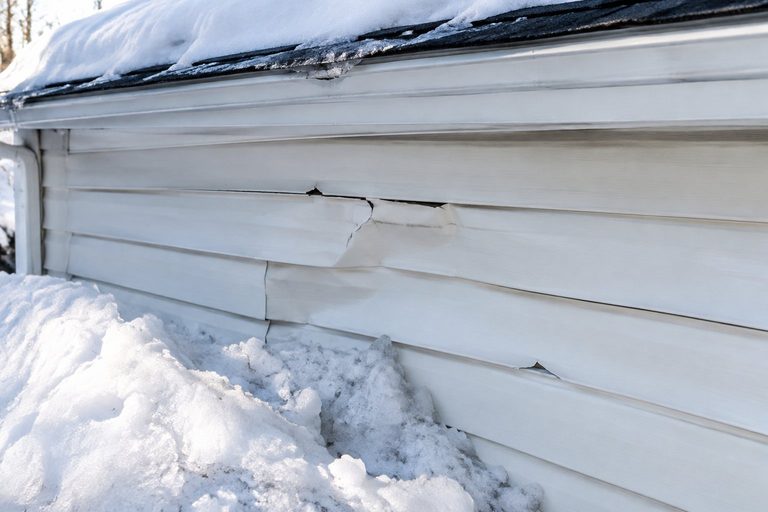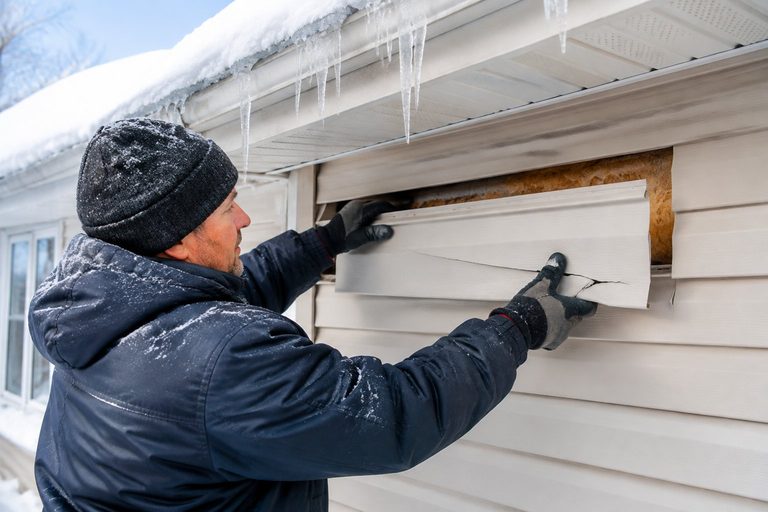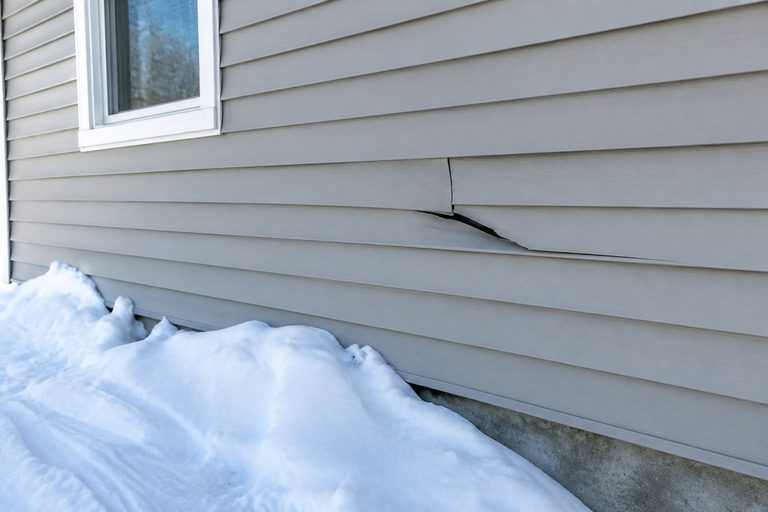
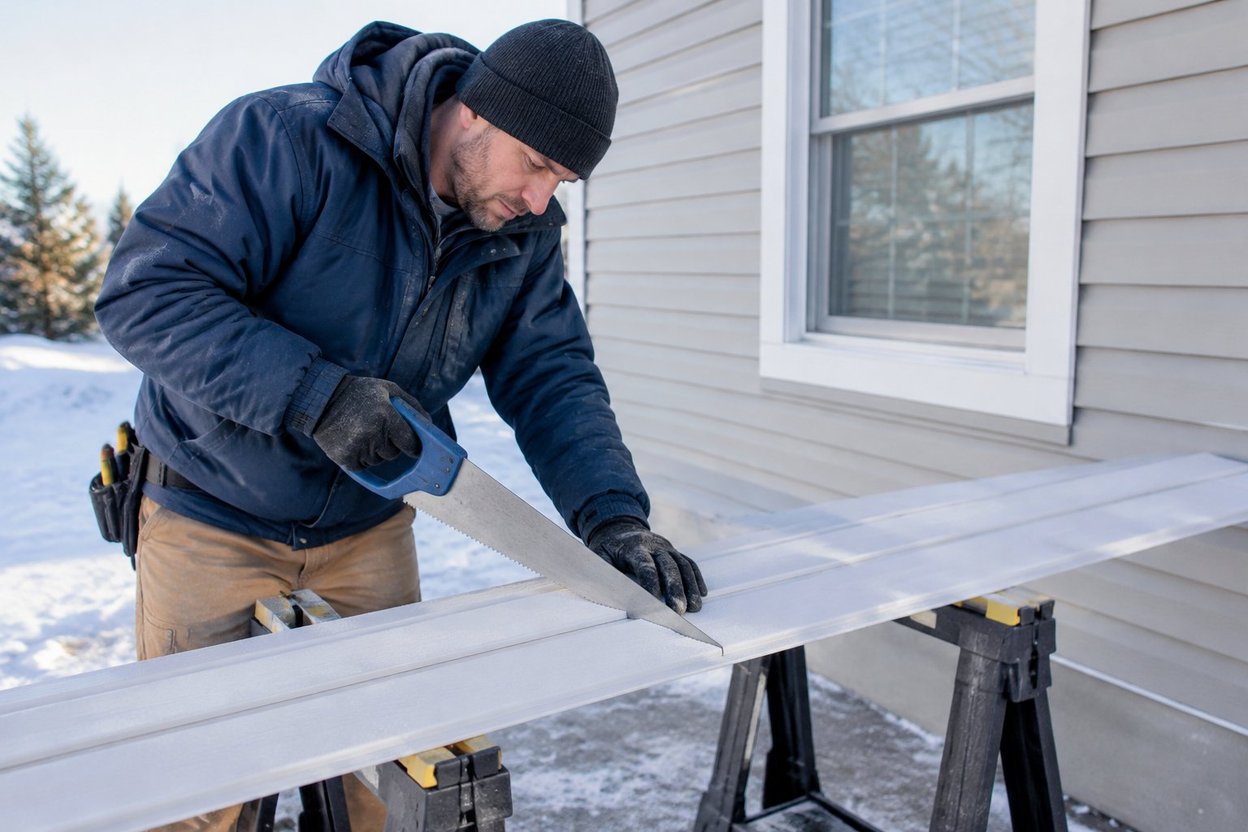
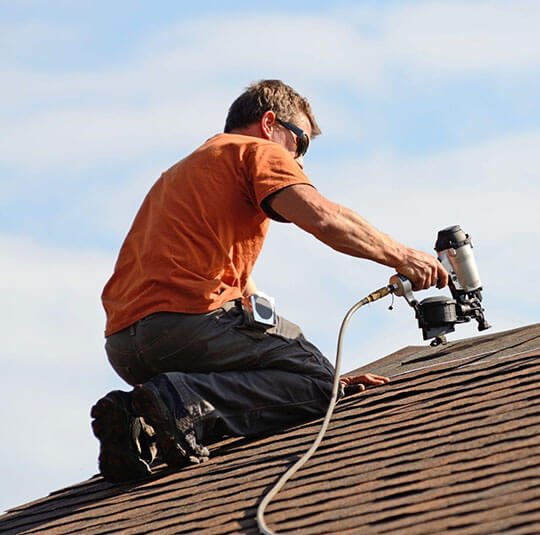
It's a gray November morning and frost is still on the lawn. You've got one cracked panel to swap before lunch. You pull a new piece off the truck, start the cut, and it splits a few inches past the line. In the cold, vinyl cuts and nails well only if you slow down. Cut gently with the right blade. Leave bigger gaps at the ends. Keep the nail heads loose so the panel can slide. And some days you should just reschedule.
The short answer
Cold vinyl gets stiff and brittle. A cut, a hammer blow or a tight nail that does nothing in July can crack it in January. The Old Farmer's Almanac warns that vinyl can become brittle at low temperatures and crack when it's nailed.
Most cold-weather cracks come from three habits:
- Rushing the cut. Forcing a saw, knife or snips through stiff vinyl puts shock into the panel.
- Driving nails tight. A nail head pinned against the flange holds the panel in place, and cold vinyl has nowhere to go.
- Leaving no room for shrinkage. A panel cut to fit snug on a cold day still moves, and it needs space to do it.
So the fix comes down to a few rules. Cut slowly with the right tool and blade. Leave bigger gaps where panels meet trim and channels. Hang every panel so it can slide side to side.
Some days are simply too cold to work vinyl, and no single official number tells you when that is. The Almanac says don't install when temperatures are likely to drop below freezing. Working contractors often push colder than that. Your manufacturer's sheet, the product itself and your own judgment on the day decide it.
Why cold vinyl cracks
Two things are going on at once.
First, the material changes. Cold vinyl loses its give. A sharp blow from a hammer, a saw blade biting too fast or snips snapping shut can start a crack instead of just making a dent or a clean edge.
Second, vinyl moves a lot. The Vinyl Siding Institute's installation tips say siding can expand and contract 1/2" or more over a 12'6" panel as the temperature changes. That's a real distance. If you nail the panel tight or butt it hard against a corner post, it can't move. When it shrinks on a cold night, the stress has to go somewhere, and it goes into the vinyl.
Fine Homebuilding makes the same point from the other side: panels stretched tight can tear when they contract in cold weather. A crack on a cold morning often isn't just bad luck. It's usually the cut, the nails or the fit.
Cutting in the cold, tool by tool
Every tool can crack cold vinyl if you force it. Here's how to use each one so it doesn't.
Circular saw. Use a fine-tooth plywood blade, installed backward. VSI, Fine Homebuilding and Gentek's installation guide all recommend this setup. A reversed fine-tooth blade gives a smoother cut in vinyl. VSI specifically says to cut slowly, especially in cold weather. Let the blade do the work, and don't shove the saw through to save ten seconds. One safety note from VSI: don't cut anything except vinyl siding with a reversed blade. Swap it back before you rip a board.
Tin snips. Snips are handy for notches and short cuts around windows and J-channel. In the cold, VSI's tip matters: don't close the blades all the way at the end of each stroke. That last snap at the tip is where the crack starts. Take shorter strokes, stop just short of closing, and move the snips forward.
Utility knife or scoring tool. For straight cuts, score the face with medium pressure, then bend the panel and snap it along the line. You don't need to cut all the way through, and in the cold you shouldn't try. Bearing down hard is how you slip or crack the panel. VSI says to wear safety goggles for all cutting and nailing. Cold vinyl can throw sharp chips, so wear them.
Fine Homebuilding also lists a hacksaw and a sliding compound miter saw as options. Whatever you use, the cold-weather rule is the same: go slow and keep the panel supported near the cut so it doesn't flex.
Hide the cut end. Cold cuts aren't always pretty, so plan where the cut edge ends up. Fine Homebuilding says to hide cut ends inside a corner post or J-channel, or under the factory edge of the overlapping panel. On a repair, that usually means the cut end goes into the channel and the factory end shows at the lap. A slightly rough cut that's hidden doesn't matter. A clean factory edge is what people see.
Nailing and gaps when it's cold
A good cut can still crack later if you nail it wrong. On a repair, this is usually where cold-weather trouble starts.
Center the nail and leave the head loose. Drive each nail in the center of the slot, straight in. Don't drive it home. VSI says to leave about 1/32" between the nail head and the panel. Fine Homebuilding says about 1/16" proud of the flange. The numbers differ a little, but the point is the same: the head holds the panel to the wall without pinning it. In the cold, a nail driven tight is the most likely way to crack a panel. Use a lighter hammer swing and stop early.
Leave bigger clearances. Where panels end at corner posts, J-channel or other stops, cold weather calls for more room. Here's what the sources say:
- VSI: at least 1/4" at openings and stops, increased to 3/8" when installing below 40°F.
- Gentek: 1/4" where panels fit into accessories, 1/2" if it's below freezing when you install.
- Fine Homebuilding: below 30°F, at least 1/2" at each panel end. Above 90°F, about 1/4".
The numbers don't match exactly because products and manufacturers differ. Follow the installation sheet for the siding you're actually putting up. If you don't have it, you know the direction: the colder it is, the bigger the gap. A panel cut a little short in the cold expands into the channel in summer. A panel cut snug in the cold buckles in summer, or cracks now.
Don't stretch the panel. When you lock a panel into the course below, Gentek says to lift it gently until the locks just touch. Fine Homebuilding says pull it snug against the lock but don't stretch it. Cranking up on a stiff panel before nailing puts it under tension, and that's the setup for a tear when it contracts overnight.
Check that it slides. After nailing, grab the panel and push it side to side. Fine Homebuilding says it should slide freely. If it doesn't, find the tight nail and back it off before you move on.
The rest of the basics still apply. VSI says to space nails no more than 16" apart on horizontal panels and every 12" on vertical panels, with at least 1 1/4" of penetration into nailable material. No face nailing, except one nail at the top of a gable. At laps, Fine Homebuilding calls for at least 1" of overlap. Gentek says to stagger laps at least 2' from course to course and not to nail within 6" of the ends of either panel. Nails near the ends of a lap pin the movement right where the panel needs it most.
Repair-job habits for the cold months
Repair work is a little easier than a full install in the cold. Most jobs are a few panels, not a whole wall, so you have more control over when and where you do the risky parts.
Cut when it's warmest. If the morning starts cold, do the pull-and-prep work first: unlock the damaged course, pull nails, check the sheathing. Make your cuts and hang the new panel later in the day, when it's warmer.
Keep the stock out of the deep cold. Don't leave your repair stock sitting in the truck bed all night if you can help it. Common sense says cold material is less forgiving than material that hasn't been sitting out overnight, but treat that as a habit, not a rule. Still cut slow and leave the cold-weather gaps no matter where the panels were stored.
Plan the day around the forecast. In the cold months, check the hourly forecast as well as the high. A mid-afternoon window on a cold week might be the only good time for the cutting and nailing.
When it's too cold, you have two honest options: wait for a warmer day, or make a temporary fix. A temporary fix means closing up the opening so water and wind stay out until you can come back and do it right. Either one beats cracking new panels on the customer's wall.
As for where to draw the line, the sources disagree. The Almanac says don't install when it's likely to drop below freezing. Contractors quoted in the Journal of Light Construction reportedly work much colder: one in Minneapolis said he stops around 20°F, and one in Wisconsin draws the line at zero, wind chill or actual. Gauge, brand and how careful you are all play a part. Nobody has one official number.
When to walk away
Sometimes the right call is to load the truck and leave.
If the thermometer is down where the panels feel like they'll snap, or you're cracking pieces on test cuts, stop. The Almanac's advice is the cautious end: don't install vinyl when temperatures are likely to drop below freezing. Plenty of working contractors go colder than that, and you may too, with slow cuts, loose nails and big gaps. But a cracked new panel costs you the material and another trip.
Tell the customer the reason in plain words: "Vinyl gets brittle in this cold and cracks when it's nailed. I don't want to put a panel up that splits. Let's do it on a warmer day." Most people respect that. Give them a date, close up the opening if it's open, and leave.
This work runs on hustle, and the cold season comes every year. The answer isn't to grind through every frozen morning. It's to know your limits, work the warm hours and keep your word on the reschedule. With Thanksgiving coming, a few slow days are fine.