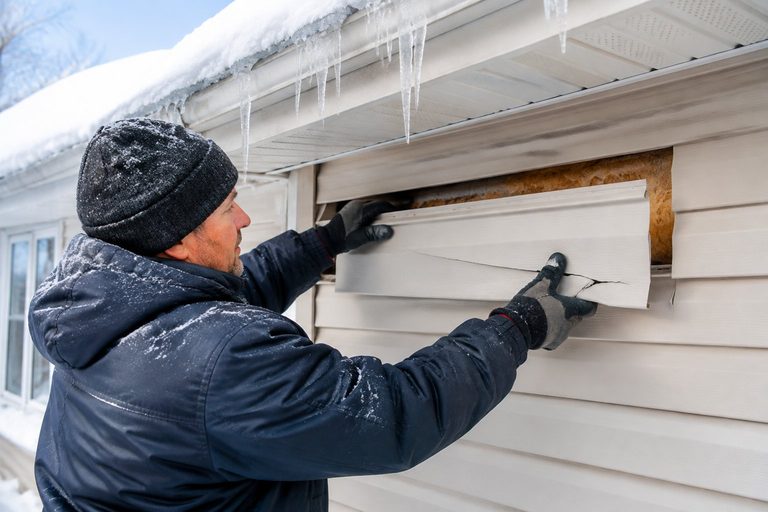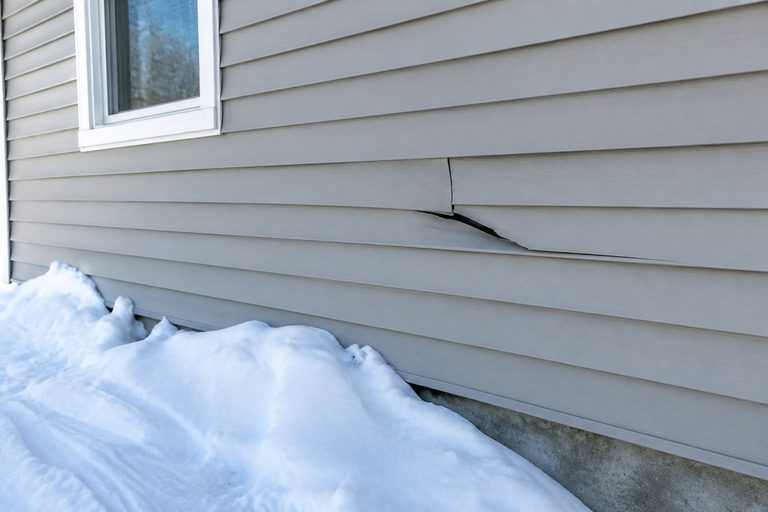
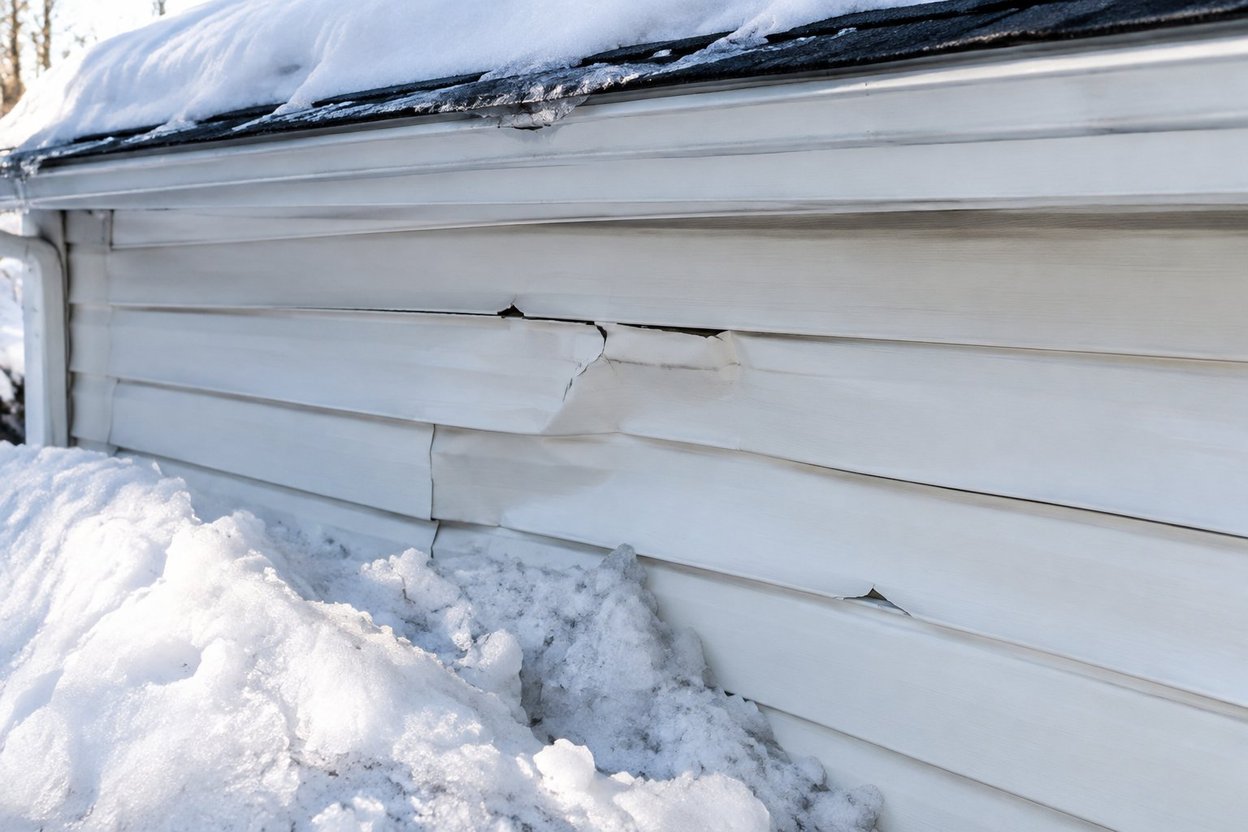
You walk the side of a house this fall, and under the low edge of the roof you find a row of cracked siding, a bent J-channel over the window, and a crease in the aluminum fascia. Last winter's snow and ice came off that roof all at once and hit the wall. Here's the fix: replace the damaged vinyl panels, replace or remake the bent metal trim, and check what's behind them before you close the wall back up. Most of these jobs are small, and you can do them well if you inspect carefully and quote carefully.
Make sure nothing can fall on you, then fix the damaged pieces
"Dented" is the word homeowners use, but it only fits some of the damage. Aluminum trim dents. Cold vinyl usually cracks or snaps instead. J-channel and window trim can bend or break. Sliding roof snow can damage walls and anything else below it, so expect the damage to look different depending on the material it hit.
One example: in a Reddit roofing thread, a homeowner said sliding snow and ice broke their siding J-channel and the edges of their window ledges. That's one person's report. It doesn't show how often this happens or whether their repair held. It does match what you'll see on these calls.
Before you take the job, ask yourself three questions:
- Is it safe to work there? If there's still snow on the roof, stay out from under it. Alaska's worker-safety guidance says to keep people out of falling-snow zones. In the fall there's usually nothing left up there, but in February there may be.
- Can you identify every material involved?
- Is the scope something you can manage?
If you can answer yes to all three, take the job.
Inspect the whole impact area before you quote
Take photos before you touch anything. Get the roof edge above, a wide shot of the impact area, and close-ups of each damaged piece. The photos help you price the job, and they help settle any later argument about what was already broken.
This is the checklist I'd suggest. It's a good business habit, not an official inspection standard:
- Siding locks: are the courses still fully locked into each other?
- Nail hems: torn, pulled over the nails, or cracked?
- Corner posts: cracked or pushed out of line?
- J-channel: bent, broken, or pulled loose?
- Window trim and head flashing: crushed or open at the top?
- Fascia: creased, loose, or wavy?
- Soffit: cracked panels, bent channel?
- Gutters: bent, pulled away, or pitched wrong?
- Flashing at roof-to-wall joints
- Any exposed backing: housewrap, foam, sheathing
Vinyl siding isn't a watertight wall covering. It depends on flashing and a water-resistive barrier behind it to keep water out. So a cracked panel with intact wrap behind it is a different job from a cracked panel with torn wrap and wet sheathing. Write down which one you've got.
Ask the homeowner two questions. Has any staining shown up inside, on the walls or ceilings? Has this happened before? Indoor stains can come from ice dams, where water backs up under the roofing. That's a separate problem from the impact mark on the wall. If they mention bowing framing, doors that suddenly stick, or creaking during heavy snow, that points to too much snow load on the roof. Federal building guidance lists those as warning signs. That isn't a siding job, so refer it out.
Replace damaged vinyl without breaking anything else
Bring these to the job:
- A zip tool
- A nail puller or flat bar
- Snips
- A tape and square
- Matching replacement panels
The process works like this:
- Hook the zip tool into the bottom lock of the course above the damaged panel and pull it down and out along its length to unlock it.
- Lift that course carefully to reach the damaged panel's nail hem.
- Pull the nails and remove the damaged panel.
- Hook the new panel into the course below and fasten it through the nail hem slots.
- Use the zip tool to lock the upper course back down over it.
Cold makes this harder. Warm vinyl is more flexible, and you have to bend the course above to reach the nails. Cold panels are more likely to crack when you do. No single temperature cutoff applies to every product. Check the instructions for the siding you're working on, and look at the conditions on the wall that day. Late October afternoons are often warm enough. A January morning may not be.
Nail so the panel can still move. Vinyl expands and contracts, so it has to hang on the fasteners, not get clamped to the wall. The VSI installation manual calls for about 1/32 inch between the fastener head and the siding. For nail spacing, slot centering, and end gaps, follow that product's installation instructions.
When you're done, slide the new panel side to side. It should move. Then run your hand along the full length of the upper course and confirm it's locked all the way across. If it isn't, it'll show up as a gap or a rattle in the first wind.
Handle metal trim and fiber cement by their own instructions
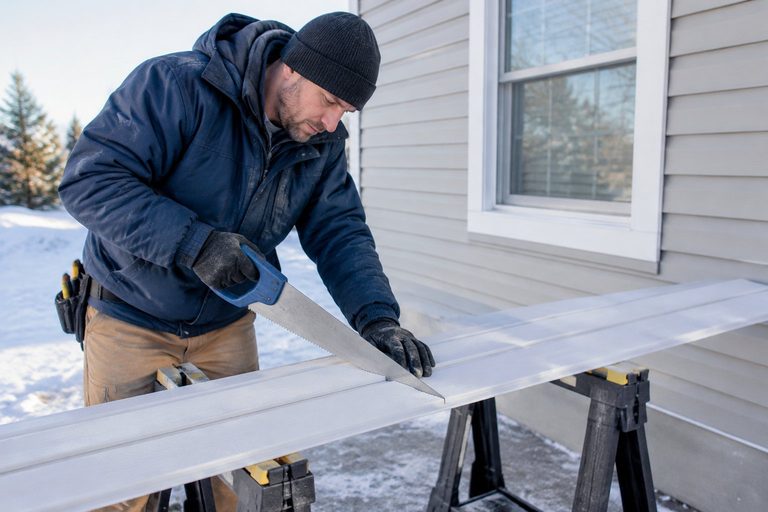
Bent J-channel or window trim usually gets replaced. Custom pieces like window trim covers can be made from trim coil on a brake. Measure the original profile, bend a test piece, and check the fit before you cut good stock.
Fascia has its own fastening rules. Berger's fascia instructions call for fastening along the underside and warn that face nailing can leave the fascia wavy or buckled as temperatures change. Other brands have their own details, so get the instructions for the system on the house.
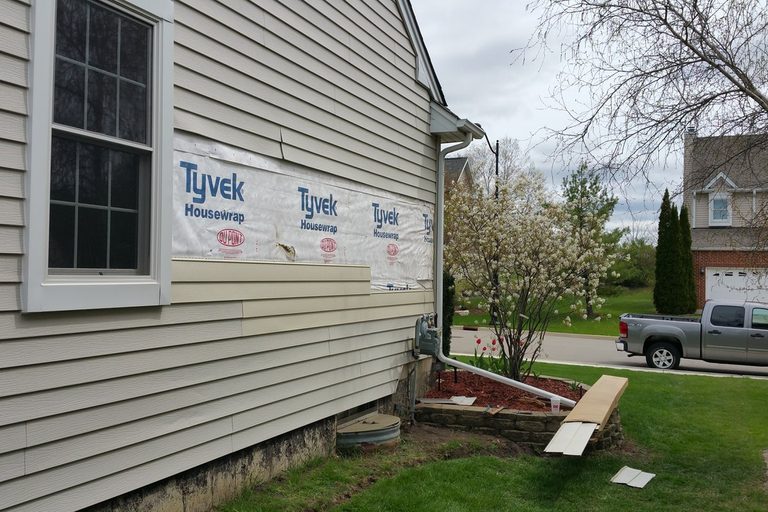
Be careful what you promise with dented aluminum. Nobody has a method that reliably makes a dent in installed trim invisible. Plan to replace it, and tell the homeowner that new coil may not exactly match trim that has weathered for twenty years.
Fiber cement is a different material with different rules. James Hardie says small cracks, chips, and dents in its siding can be repaired with a cementitious patching compound. That covers minor surface damage on that brand. It doesn't make filler the fix for a broken board. Broken boards get replaced according to the manufacturer's instructions.
Build the quote around the work you can see
There's no national price for this repair, so build the quote line by line from the actual job. A structure I'd suggest:
- Identifying the material and finding a match. This Old House suggests taking a piece of the existing siding to a distributor.
- Removing the damaged panels and trim
- Inspecting the backing
- Replacement material, priced locally
- Fabricating trim on the brake
- Access: ladders, staging, roof edge
- Disposal
- Finishing, if any is needed
In writing, state:
- The exact repair area
- The material you plan to use
- What it will look like. New panels on a faded wall will probably stand out.
- How concealed damage will be handled. Anything you find behind the siding gets photographed and approved by the homeowner before you repair it.
That keeps a small quote from turning into an argument.
Licensing and insurance depend on where you work. Check yours before you take jobs like this.
Finish the repair, and refer the roof problem to a roofer
When you're done, take completion photos from the same angles as your "before" shots. Check the locks, the fastening, and where water drains: head flashing, J-channel, gutter pitch.
Then tell the homeowner the truth. New siding won't stop the next slide. If the roof sheds snow onto that wall, it'll happen again. Whether snow guards would help depends on that roof's snow load, slope, and size. No standard layout fits every house, so that's a job for a qualified roof specialist. Explain the difference between the two problems too. Sliding snow hits the wall from outside. Ice dams push water up under the roofing. They need different fixes and different trades.
When I narrowed my business down to vinyl siding repair, the point was to take jobs I could do safely and well. Do the siding repair. Bring in a roofer for the roof, and the right specialist for structural problems or hidden damage beyond your scope.
Sources (13)
- S-5! snow-retention guide
- Metal Construction Association cold-climate roofing bulletin
- Reddit r/Roofing discussion on sliding ice
- Alaska Department of Labor: snow-removal hazards
- VSI Vinyl Siding Installation Manual
- Wolverine siding installation guide
- University of Minnesota Extension: ice dams
- National Weather Service: roof ice dams
- Building America Solution Center: managing snow loads
- PEPA repair tips
- This Old House: repairing vinyl siding
- Berger fascia and soffit instructions
- James Hardie FAQ